

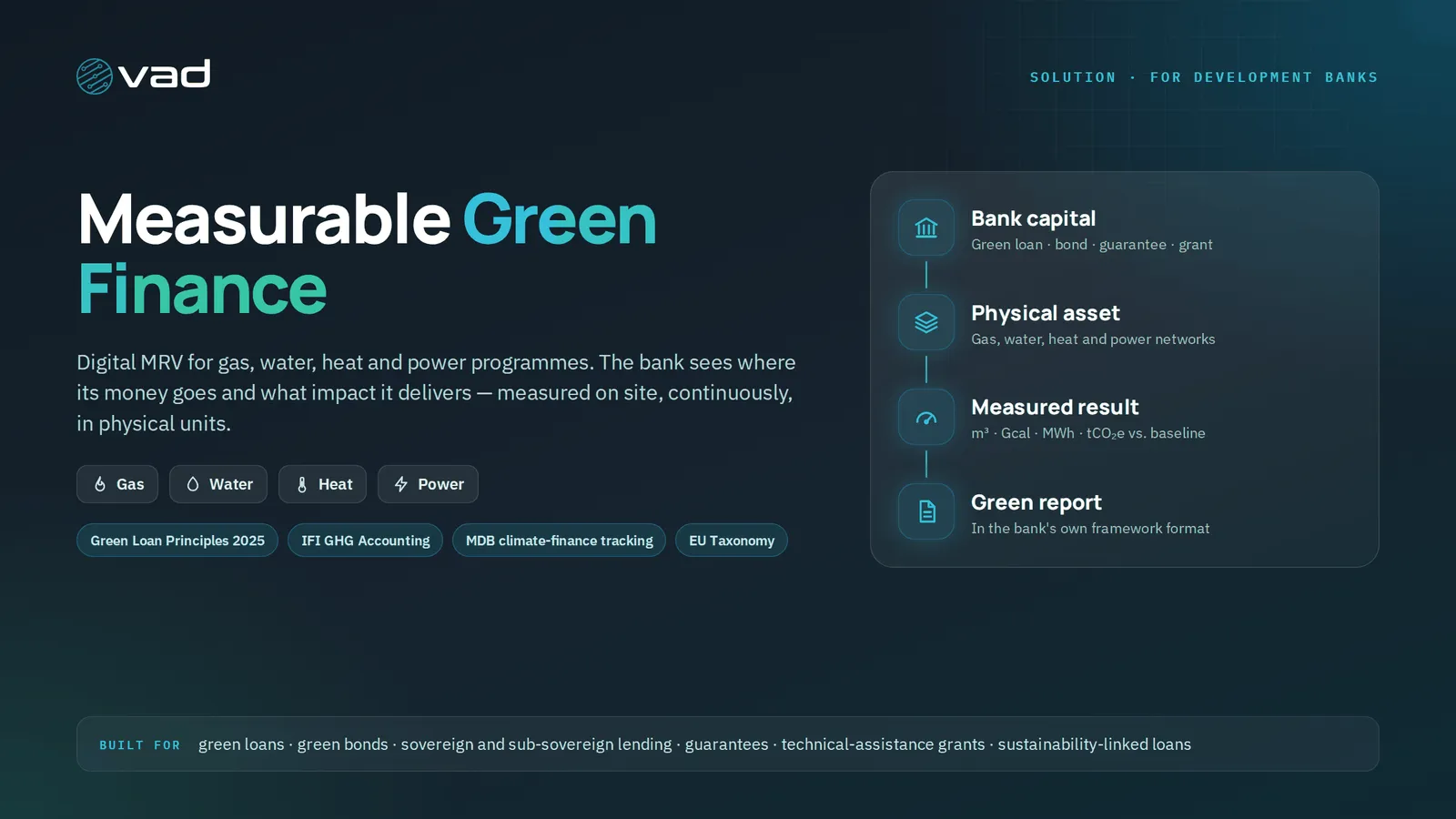
Measurable Green Finance — Digital MRV for Development Banks
Digital MRV for gas, water, heat and power programmes: the bank sees where its money goes and what impact it delivers — measured on site, continuously, in physical units.
Development banks are channelling record volumes into green and climate finance, and the more green loans there are, the sharper the central question becomes: how do you prove that the impact is real? VAD Green Finance is digital infrastructure that connects a bank’s capital with independently measured results on gas, water, heat and power networks. Before financing, VAD calculates the decarbonisation case — the baseline of resource losses and emissions and the expected reduction. After launch, the platform measures the actual result directly on site, in cubic metres, gigacalories and tonnes of CO₂-equivalent. The bank sees the improvement it finances immediately and continuously — not through a contractor’s report at the end of the year.
Why Now
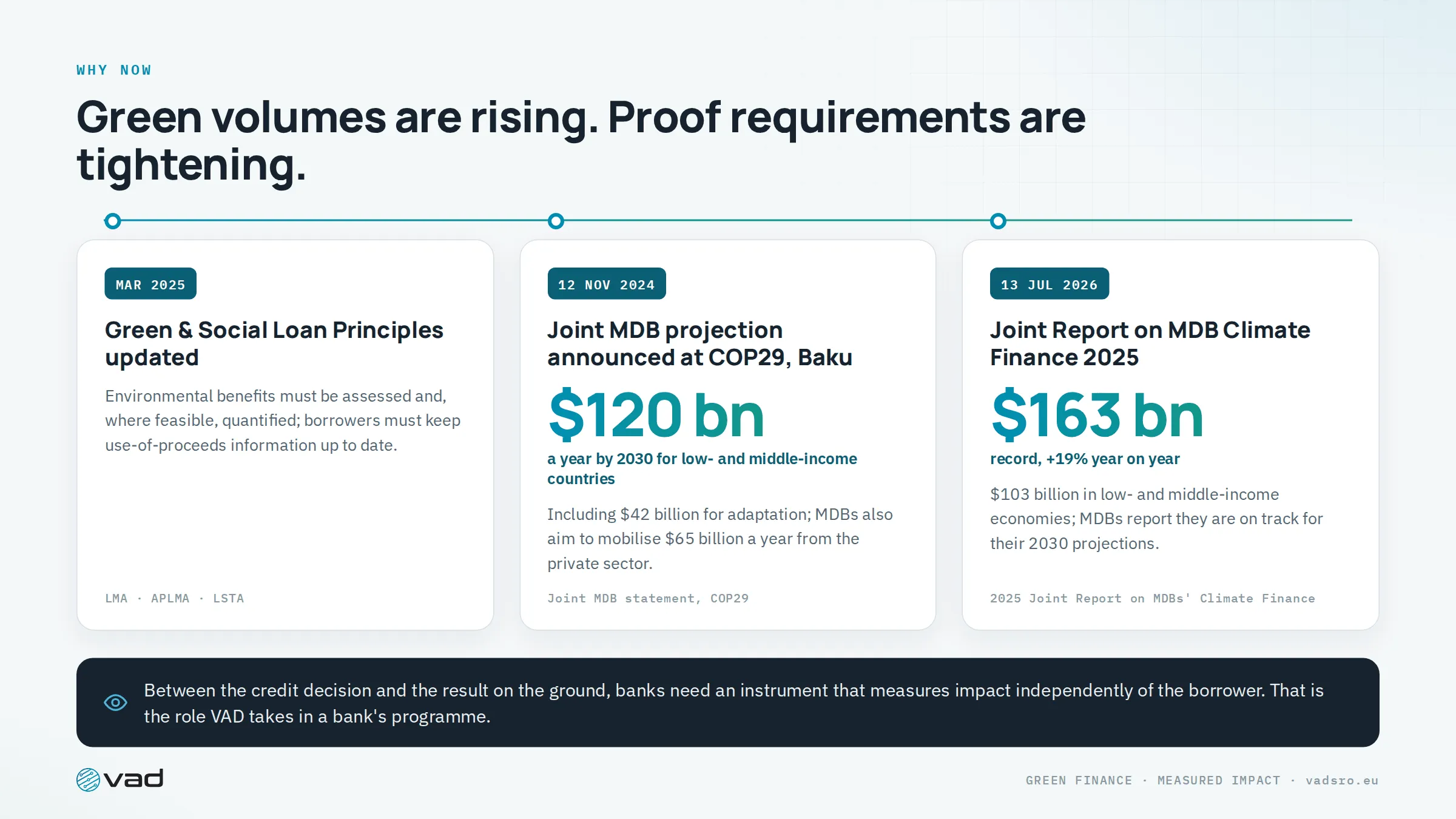
Green volumes are rising and the requirements for proof are tightening at the same time. The 2025 Joint Report on Multilateral Development Banks’ Climate Finance, published on 13 July 2026, shows a record $163 billion in MDB climate finance for 2025, up 19% year on year, of which $103 billion went to low- and middle-income economies. At COP29 in Baku the development banks jointly projected that by 2030 their annual climate finance for low- and middle-income countries will reach $120 billion, including $42 billion for adaptation, with a further $65 billion a year to be mobilised from the private sector.
From Declared Impact to Measured Impact
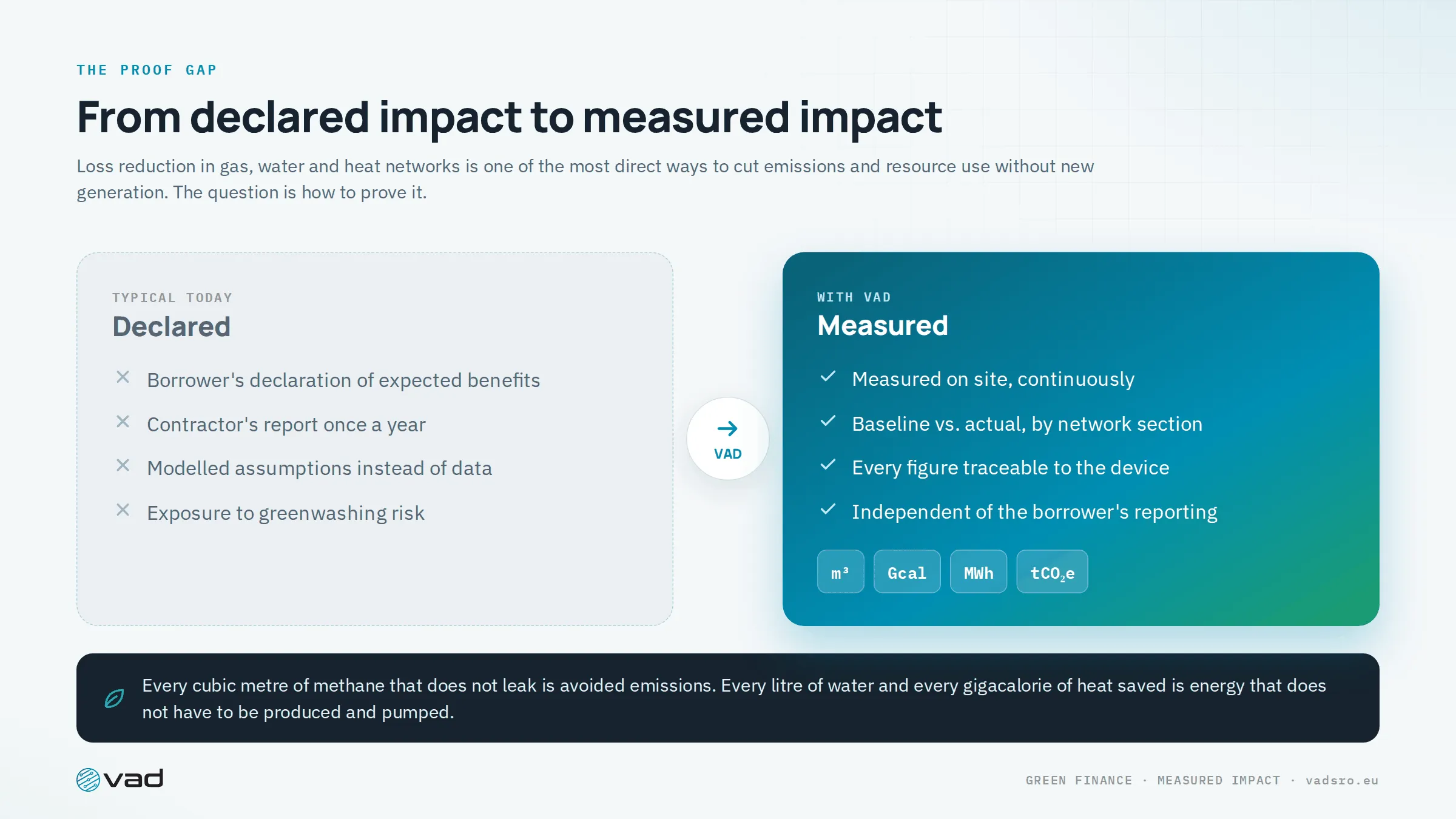
Reducing losses of gas, water and heat in networks is one of the most direct ways to cut emissions and resource use without building new generation. Every cubic metre of methane that does not leak is avoided emissions. Every litre of water and every gigacalorie of heat saved is energy that does not have to be produced and pumped. Such programmes match the categories of green finance by their substance — energy efficiency, methane emission reduction, sustainable use of water resources and climate resilience of infrastructure. The final qualification of a project is always determined under the bank’s own methodology.
What banks usually get today is a declaration: the borrower’s statement of expected benefits, a contractor’s annual report and modelled assumptions. VAD replaces it with measurement — on site, continuously, by network section, in physical units, and traceable to the device.
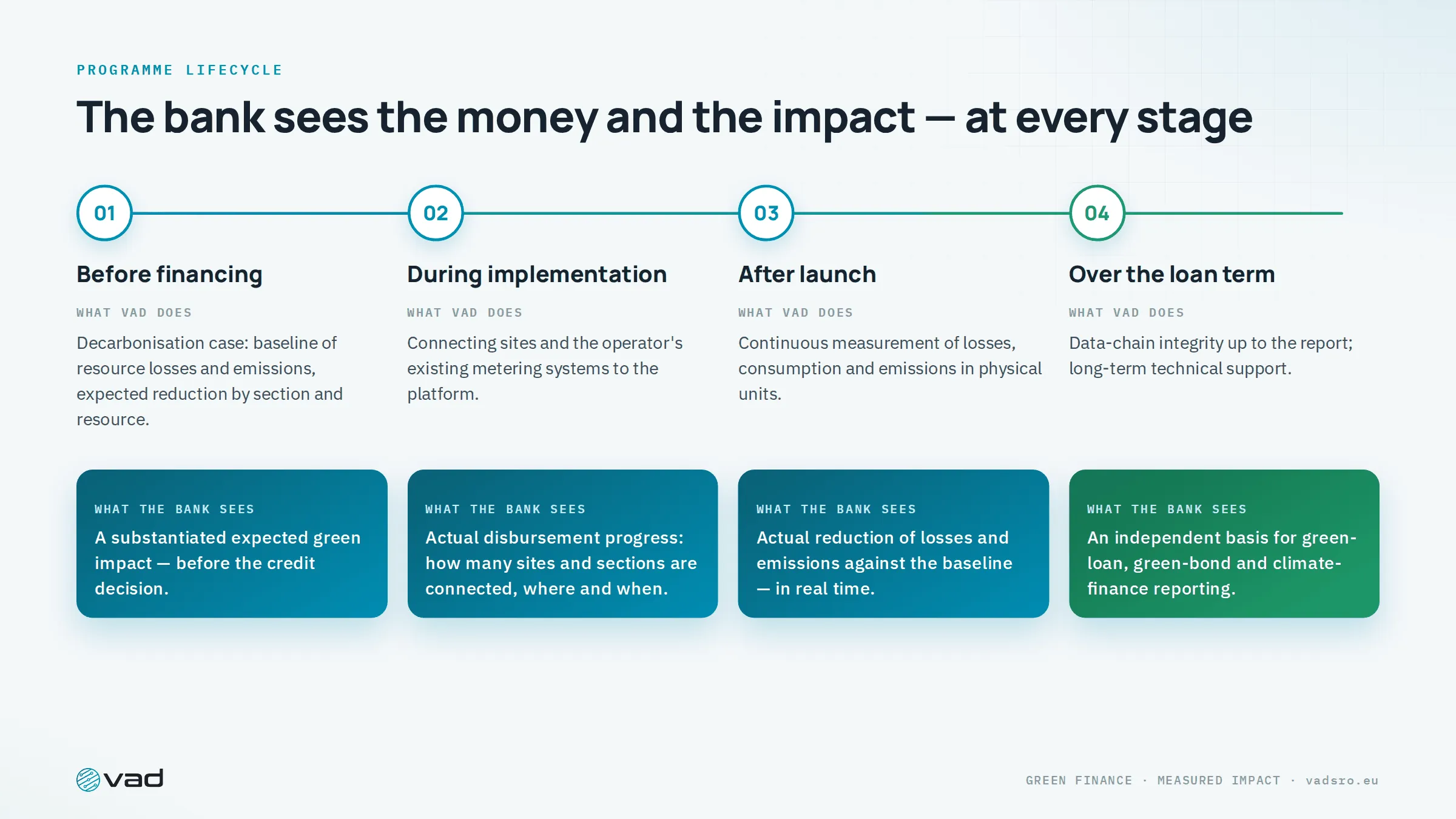
The Bank Sees the Money and the Impact — at Every Stage
| Stage | What VAD does | What the bank sees |
|---|---|---|
| Before financing | Decarbonisation case: baseline of losses and emissions, expected reduction by section and resource | A substantiated expected green impact before the credit decision |
| During implementation | Connecting sites and the operator’s existing metering systems to the platform | Actual disbursement progress: how many sites and sections are connected, where and when |
| After launch | Continuous measurement of losses, consumption and emissions in physical units | Actual reduction of losses and emissions against the baseline, in real time |
| Over the loan term | Data-chain integrity up to the report; technical support | An independent basis for green-loan, green-bond and climate-finance reporting |
No Metric Without Provenance
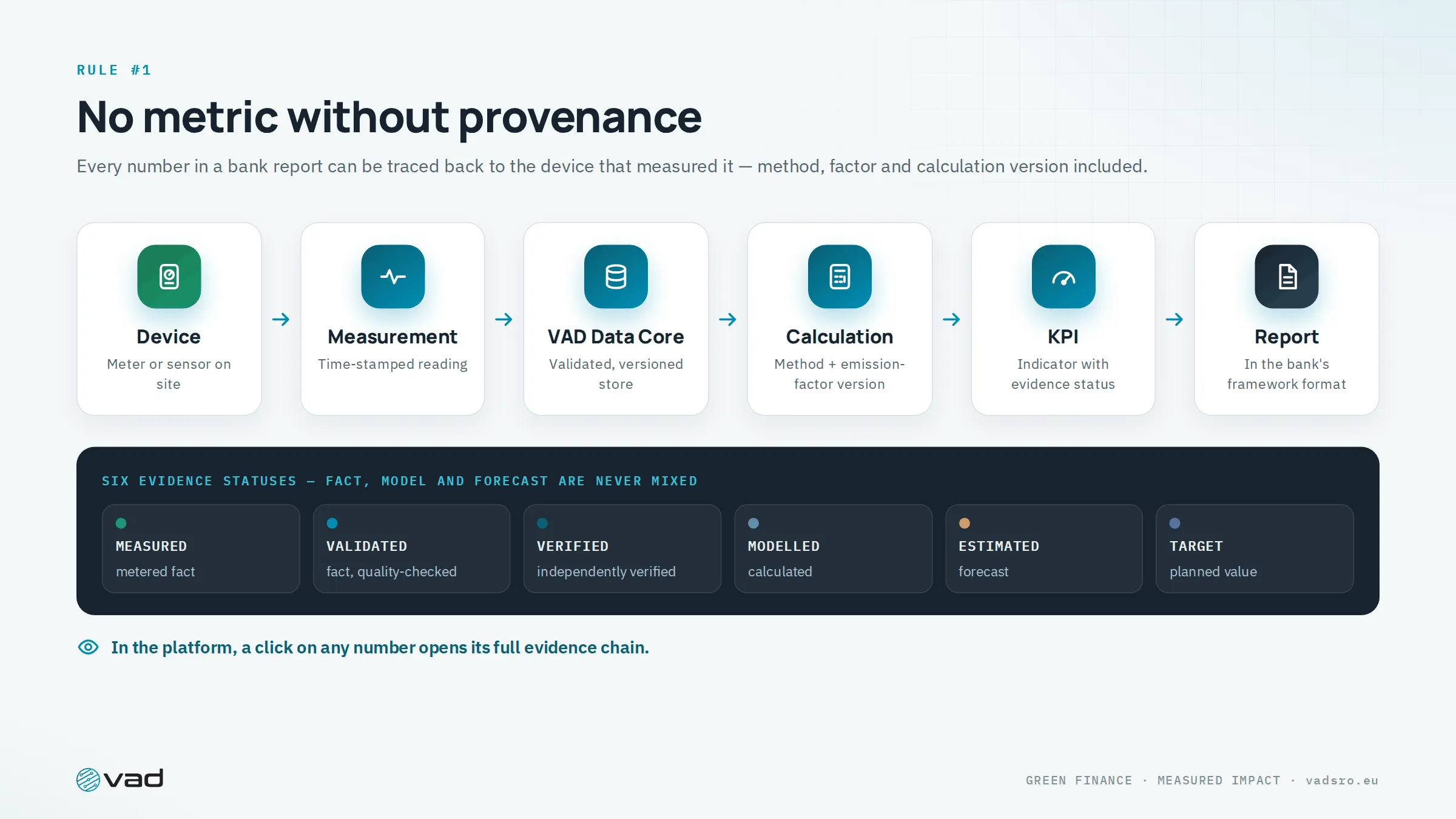
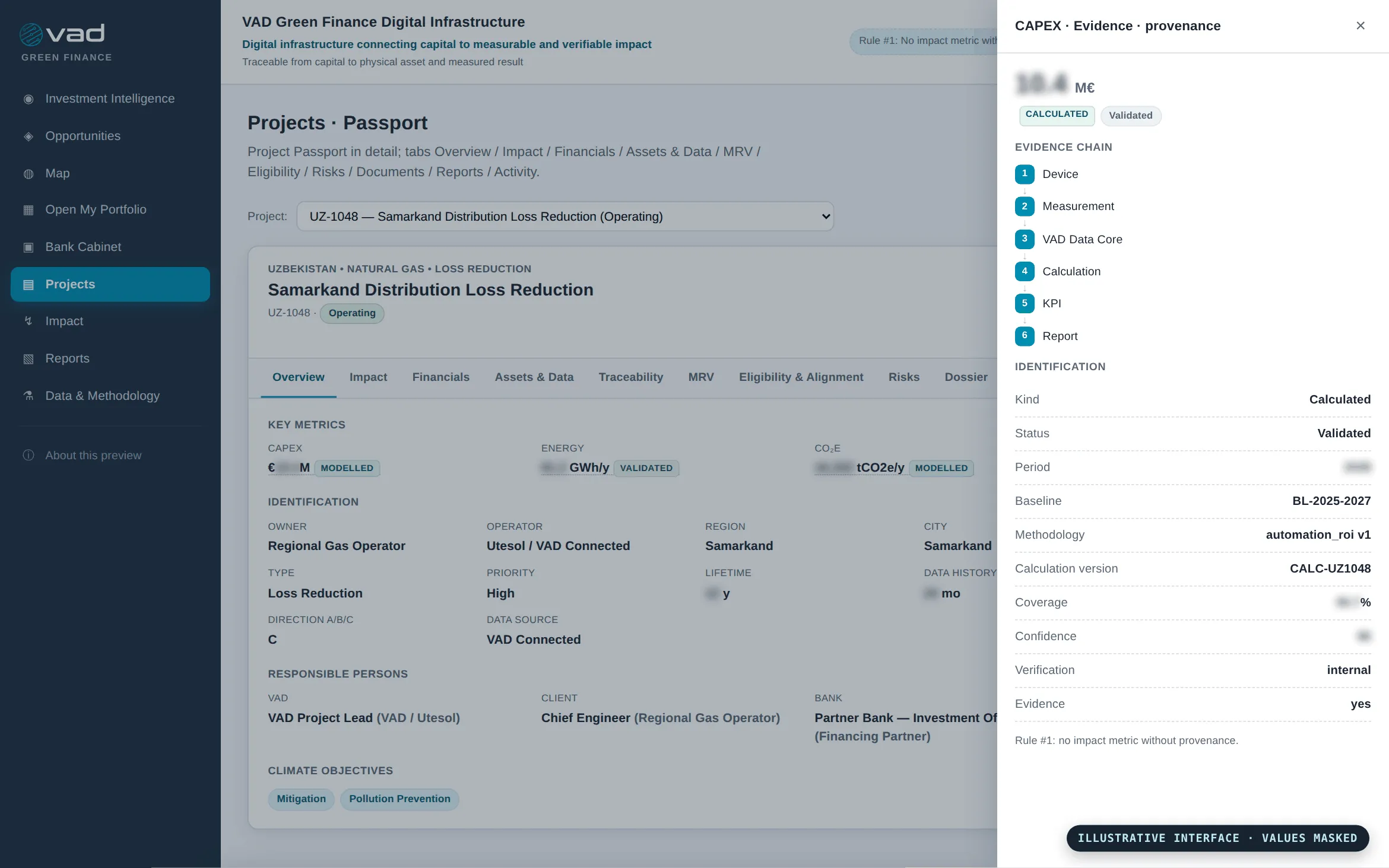
The core rule of the platform is simple: no impact metric without provenance. Every number is a metric object — value, unit, period, status, source, methodology, calculation version, confidence and verification — and can be traced along the evidence chain Device → Measurement → VAD Data Core → Calculation → KPI → Report.
Six evidence statuses keep fact, model and forecast apart:
| Status | Meaning |
|---|---|
| MEASURED | Metered fact |
| VALIDATED | Fact, quality-checked |
| VERIFIED | Independently verified |
| MODELLED | Calculated value |
| ESTIMATED | Forecast |
| TARGET | Planned value |
The Platform
The Green Finance showcase is part of the IIoT Ecosystem. Access is protected by single sign-on, and the interface adapts to the user’s role — bank or VAD operator.
Investment Intelligence
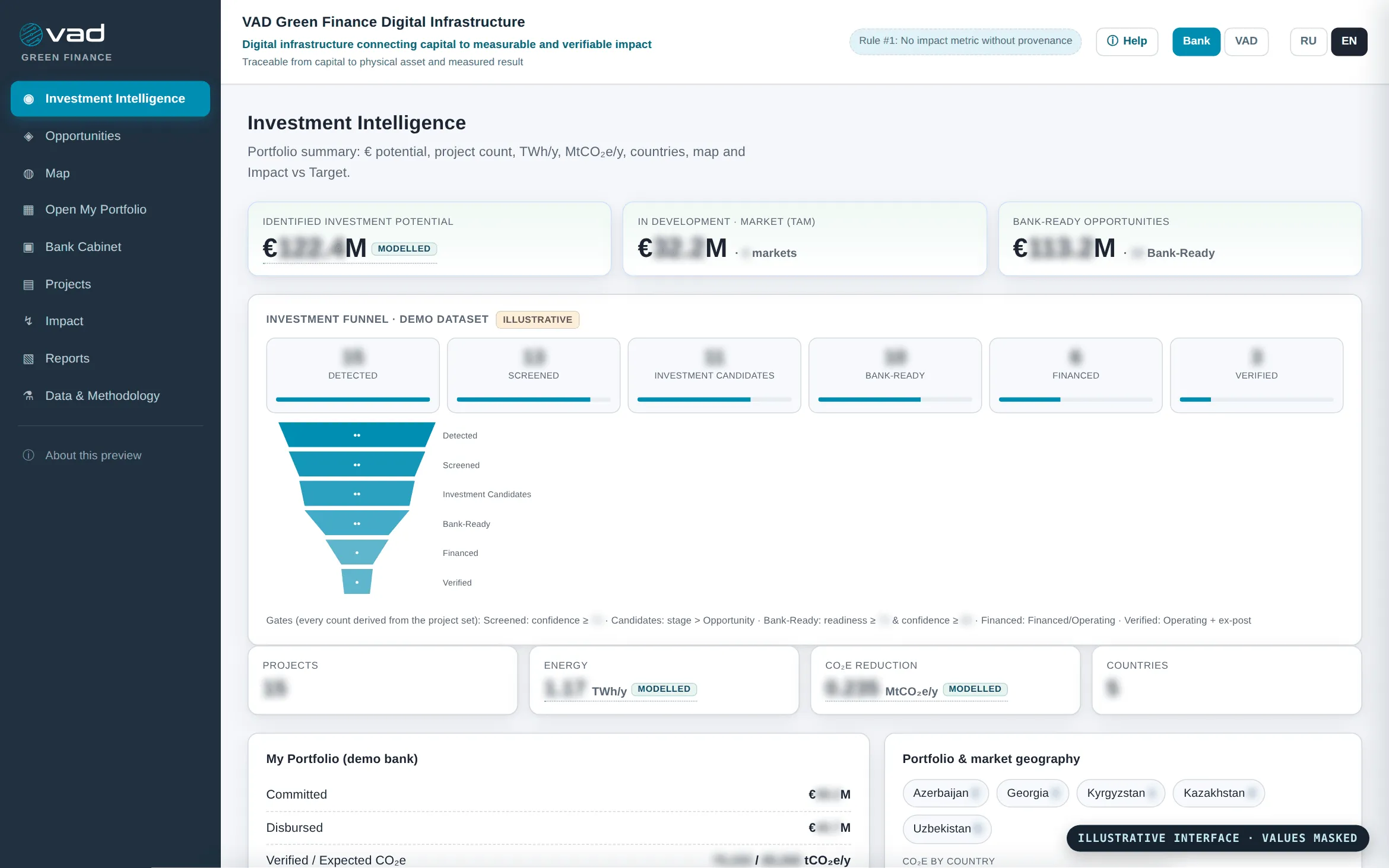
The landing screen puts three figures side by side, each with its own provenance: the investment potential of deals in the project set, the market pipeline in development, and the opportunities that are ready for the bank. Below them, the investment funnel runs from detected opportunities to verified results, and every count is derived from the project set.
Opportunities Marketplace
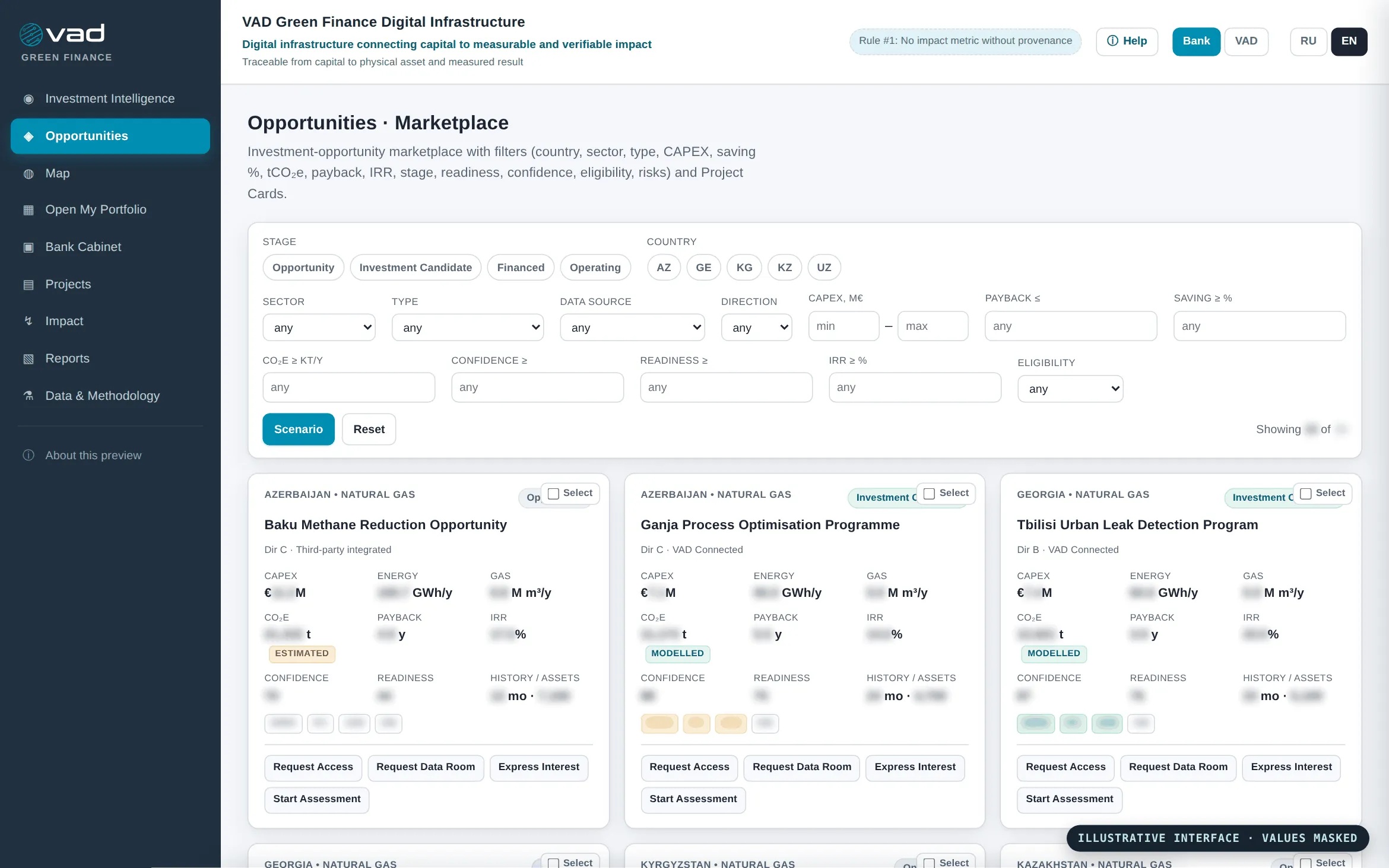
A marketplace of investment opportunities with filters by stage, country, sector, data source, CAPEX, payback, CO₂e, confidence, readiness and eligibility. Each card carries its key metrics with evidence statuses and deal-flow actions: request access, request a data room, express interest.
Country Intelligence
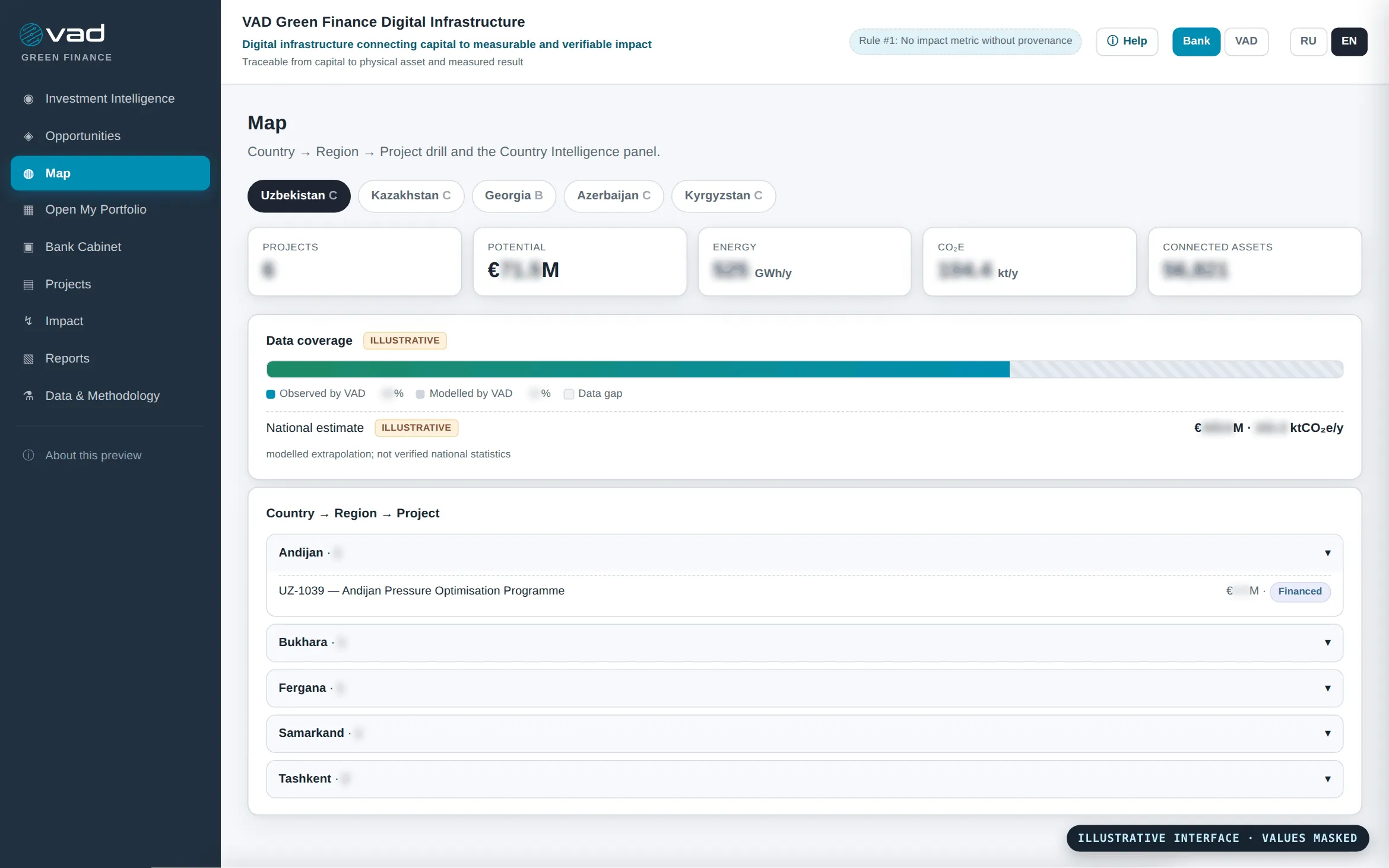
A drill-down from country to region to project, with an explicit split between what is observed by VAD and what is modelled or a data gap. Country-level estimates are labelled as illustrative wherever they are not measured.
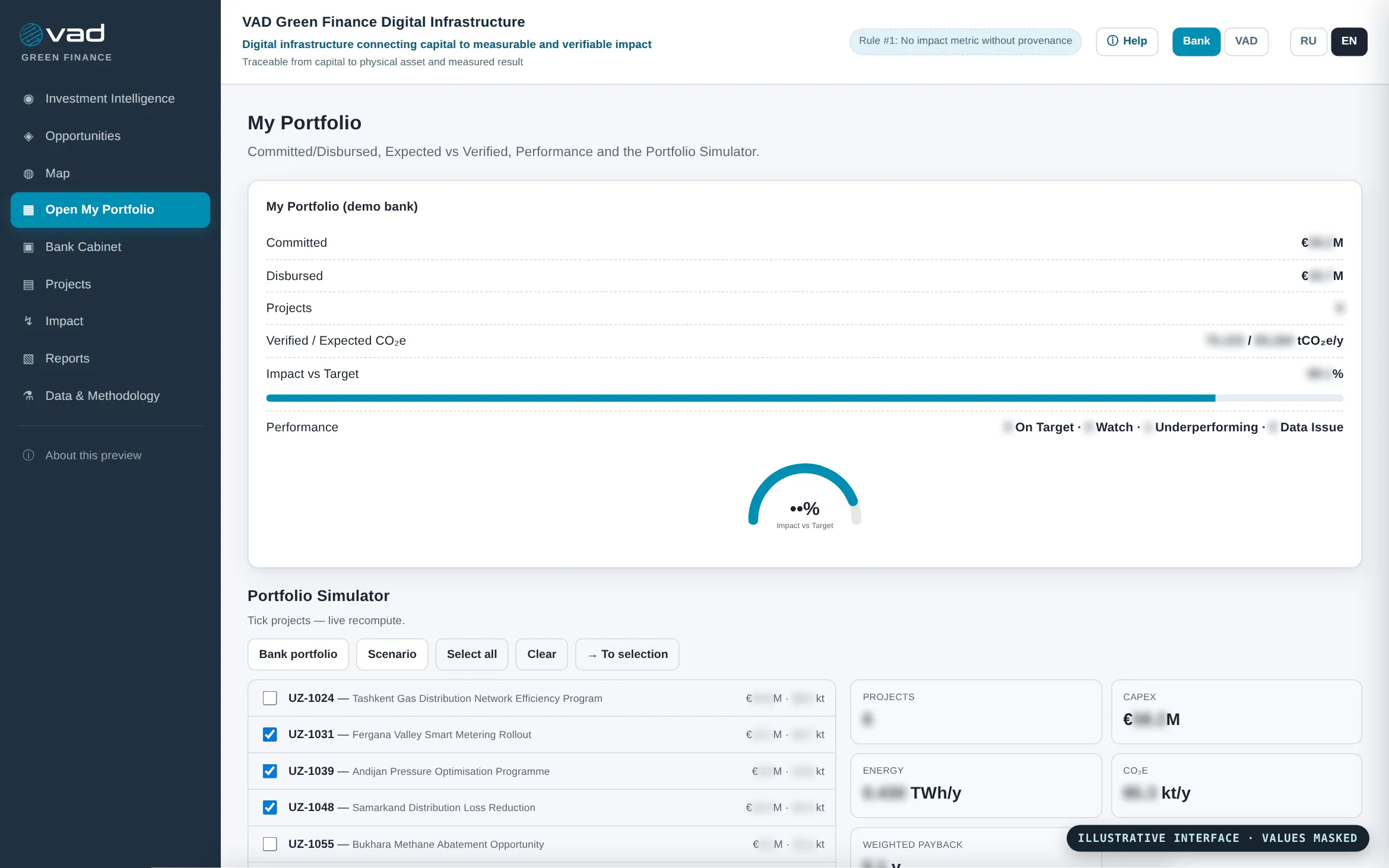
Portfolio and Simulator
The bank’s portfolio view — committed and disbursed amounts, verified versus expected CO₂e, impact against target — with a portfolio simulator: tick projects and the aggregates recompute live.
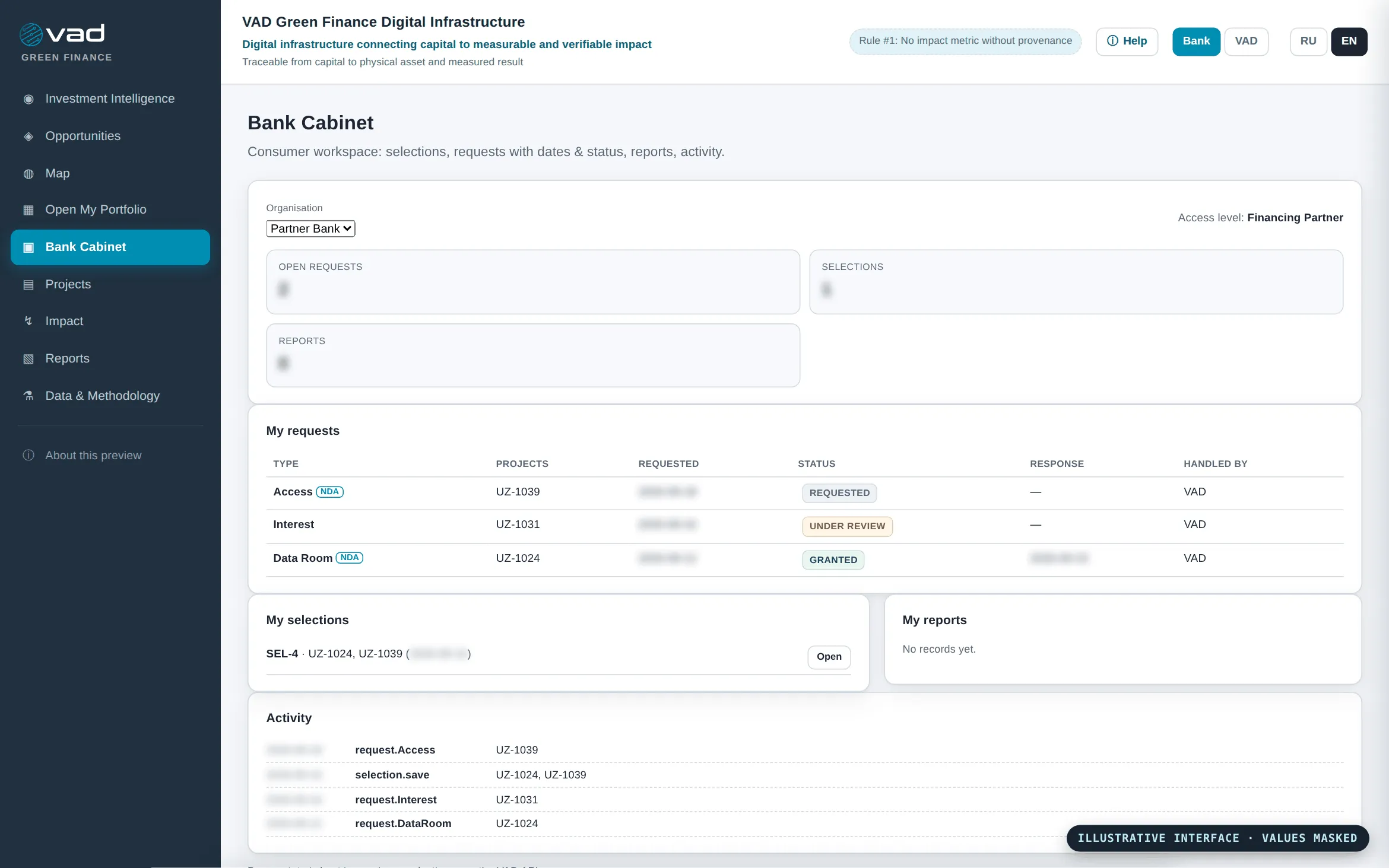
Bank Cabinet
The bank’s workspace: saved selections, requests with dates and statuses, generated reports and an activity log. The VAD operator processes the bank’s requests, and status changes are reflected in the cabinet.
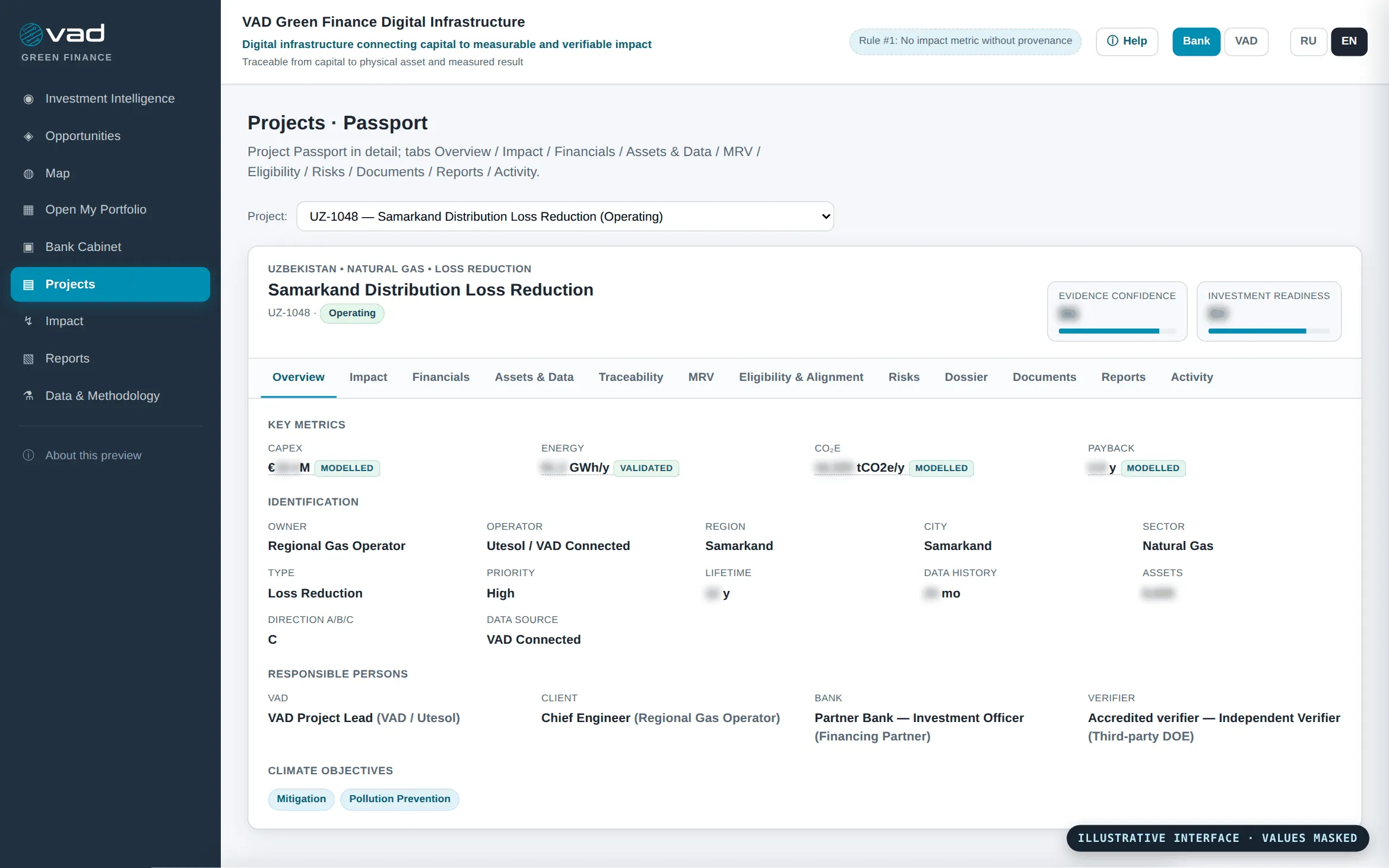
Project Passport
A full project passport with tabs for overview, impact, financials, assets and data, traceability, MRV, eligibility and alignment, risks, dossier, documents, reports and activity. The dossier keeps a dated timeline of the deal, notes and attached documents.
Evidence Panel
Click any dotted number and the evidence panel opens: the value, its status, the evidence chain from device to report, the period, baseline, methodology, calculation version, coverage, confidence and verification.
Impact
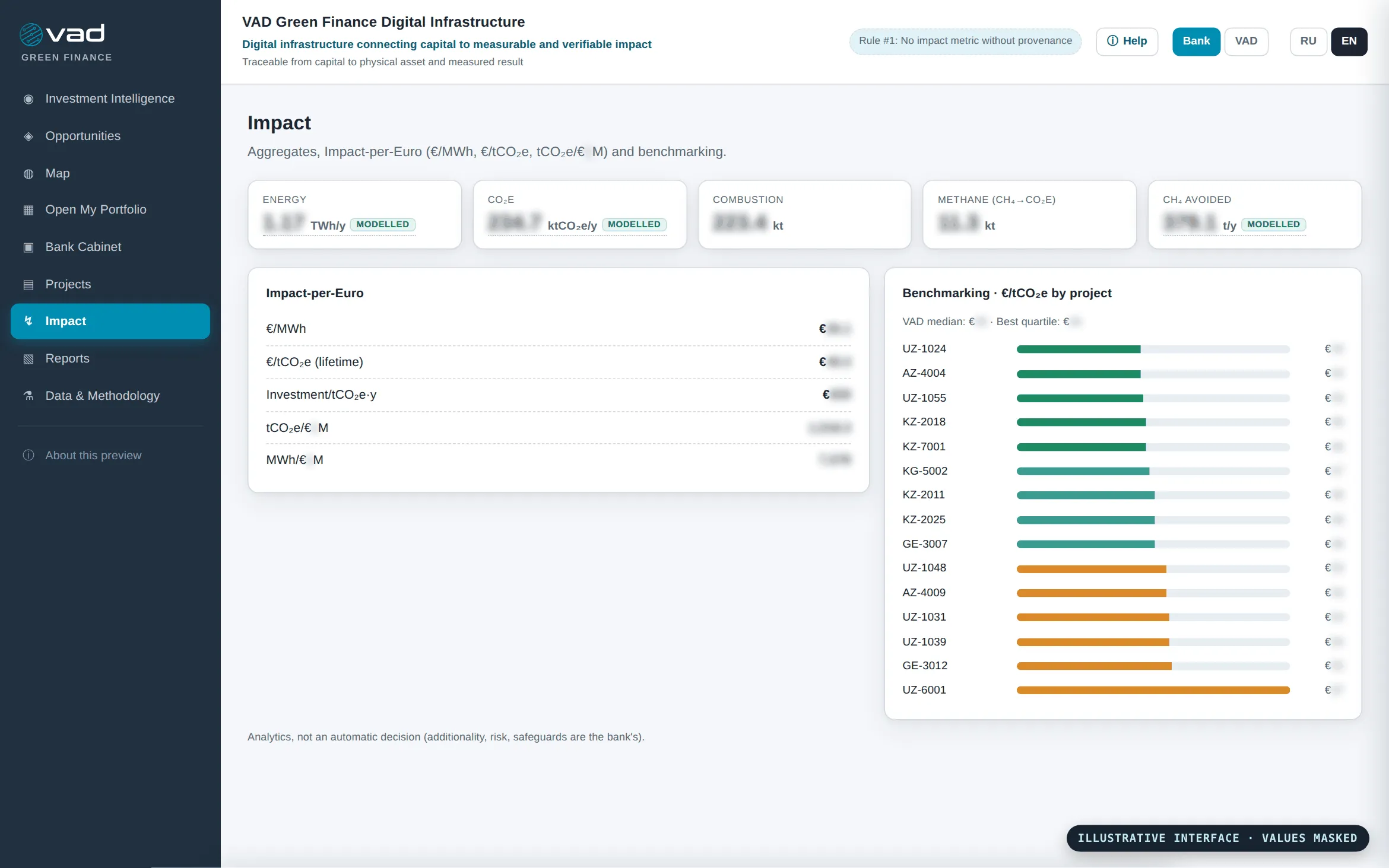
Aggregate energy, CO₂e, combustion, methane and CH₄ avoided, impact per euro (€/MWh, €/tCO₂e over the lifetime, tCO₂e per €1 m) and benchmarking of €/tCO₂e across projects. It is analytics, not an automatic decision: additionality, risk and safeguards remain with the bank.
Report Builder
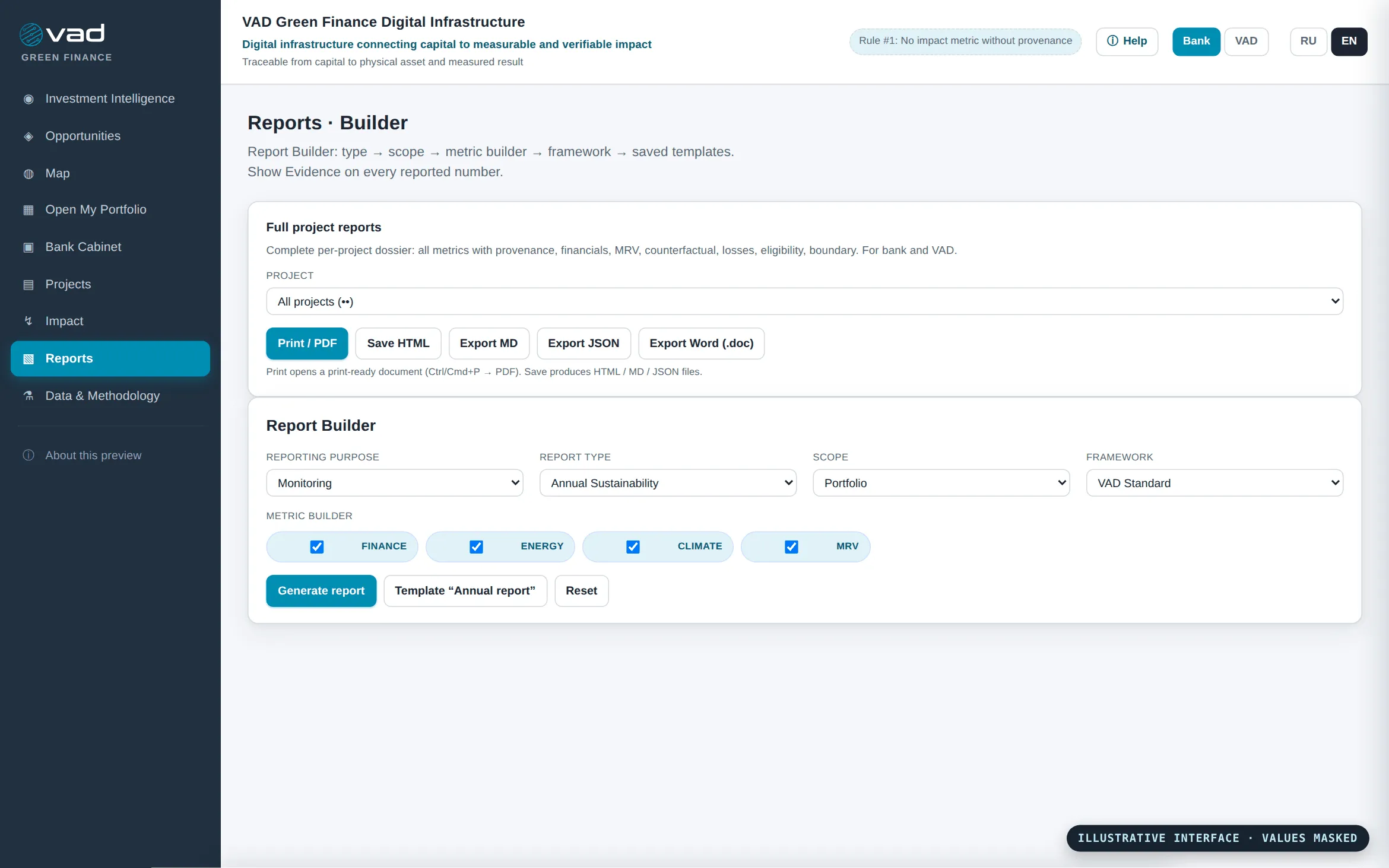
Full project reports and a report builder by purpose, type, scope and framework, with export to PDF, HTML, Markdown, JSON and Word. Exports are machine-readable and carry provenance columns, in line with ICMA and MDB expectations for methodological transparency.
Data and Methodology
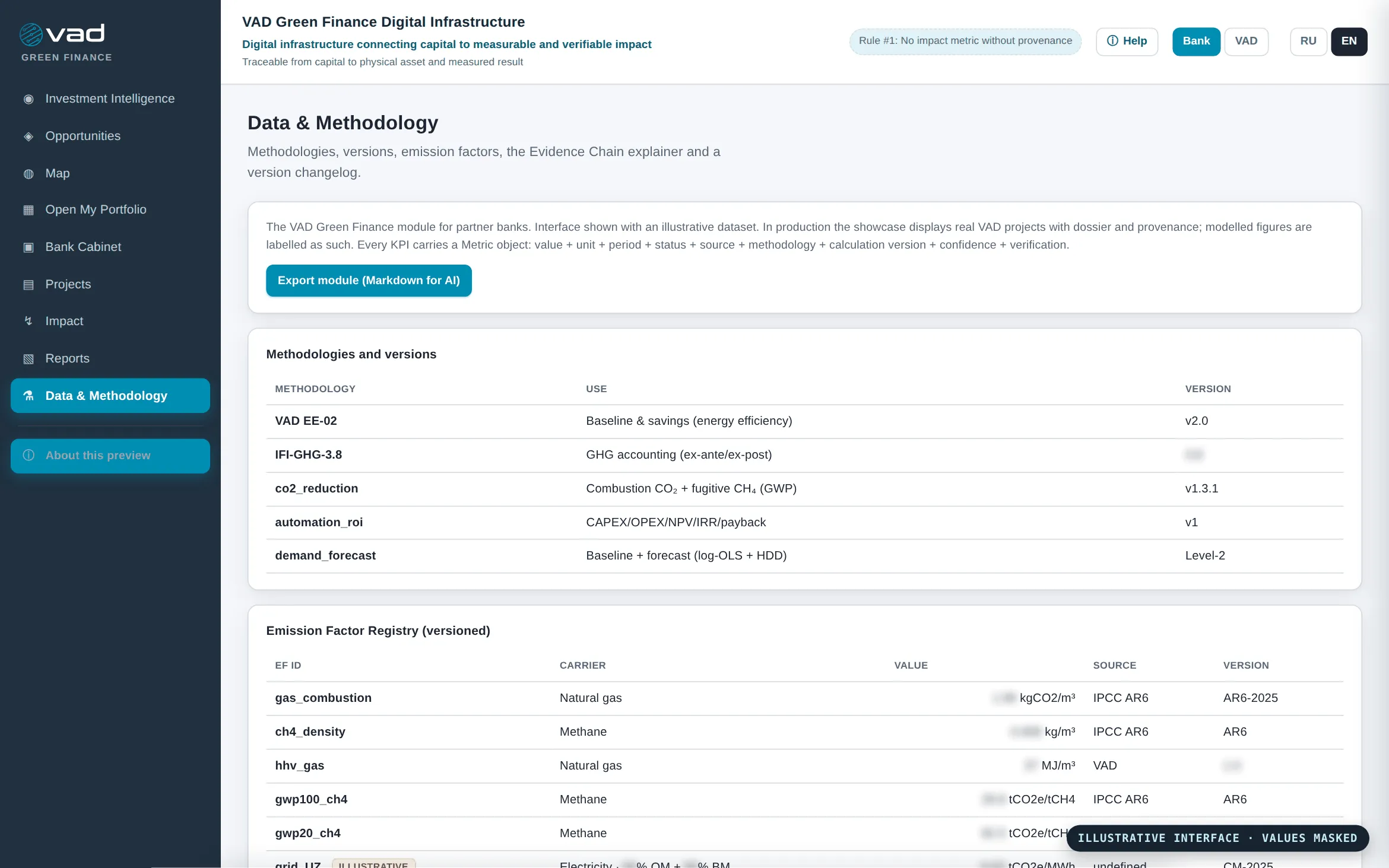
Versioned methodologies and registries of emission factors and frameworks. A recalculation under an updated methodology creates a new version; both versions stay available.
Four Axes, Kept Separate
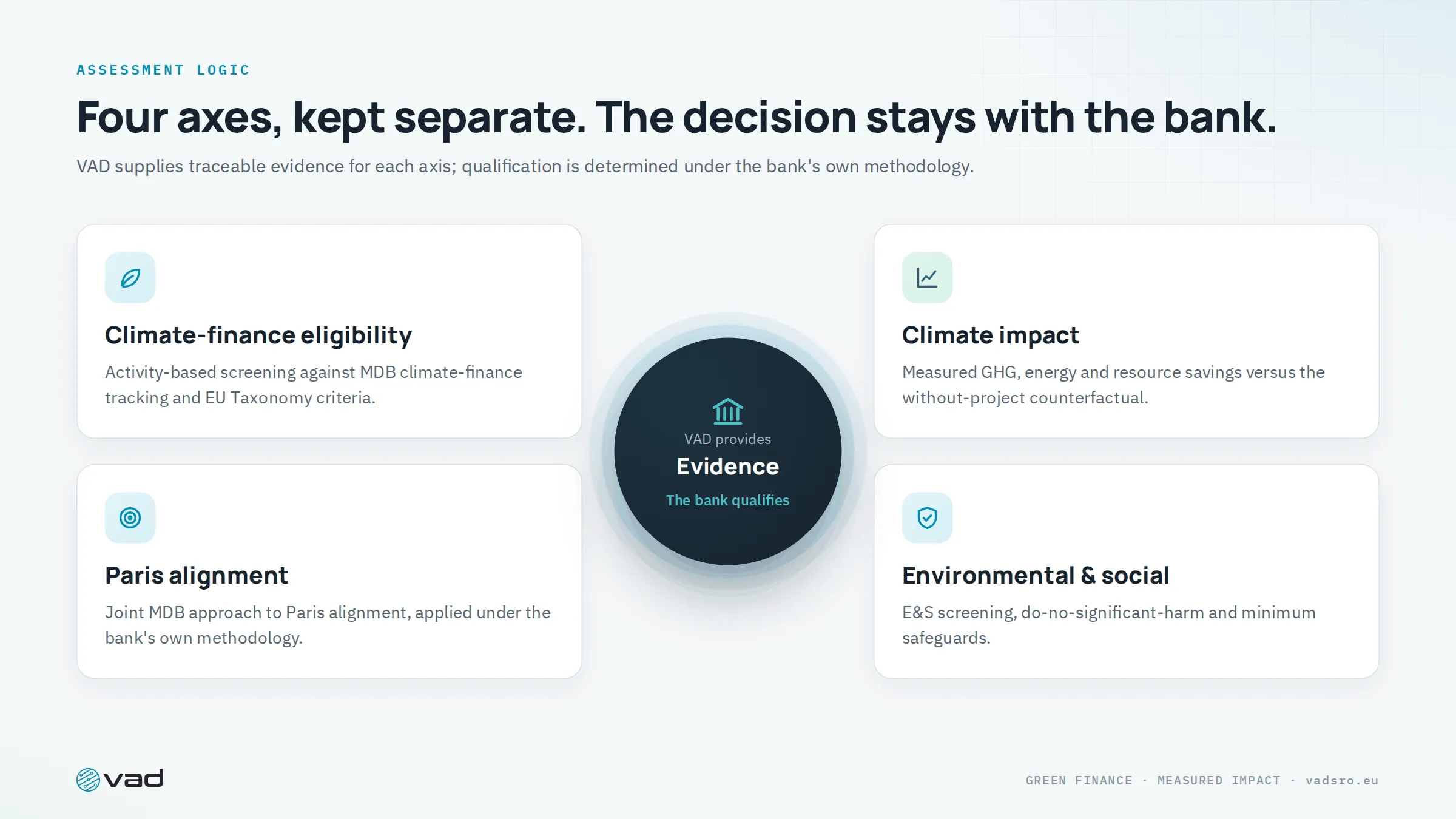
Climate-finance eligibility, climate impact, Paris alignment and environmental and social aspects are assessed on four separate axes and are never mixed into one score. VAD supplies traceable evidence for each axis; the qualification decision stays with the bank.
Climate-finance eligibility — activity-based screening against MDB climate-finance tracking and EU Taxonomy criteria.
Climate impact — measured GHG, energy and resource savings versus the without-project counterfactual.
Paris alignment — the joint MDB approach to Paris alignment, applied under the bank’s own methodology.
Environmental and social — E&S screening, do-no-significant-harm and minimum safeguards.
MDB Reporting Compatibility
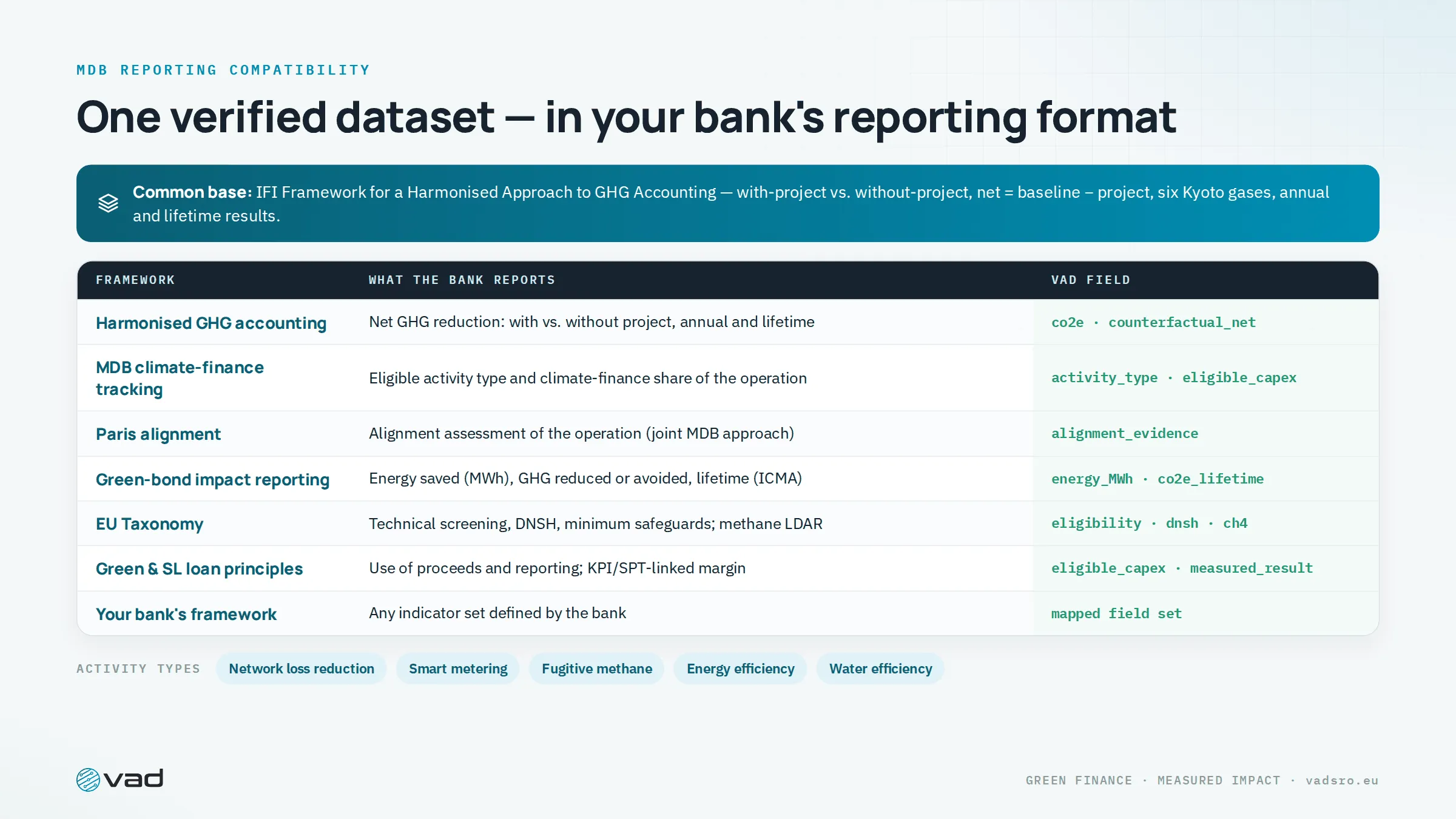
VAD’s calculation method already matches the common base that development banks use — the IFI Framework for a Harmonised Approach to GHG Accounting: impact is the difference between the with-project and without-project scenarios, net reduction equals baseline minus project, the six Kyoto gases are covered, and results are reported per year and over the lifetime. One verified dataset is then mapped into your bank’s own reporting format — whichever framework it uses.
| Framework | What the bank reports | VAD metric |
|---|---|---|
| Harmonised GHG accounting | Net GHG reduction, with versus without project, annual and lifetime | GHG reduction, counterfactual net |
| MDB climate-finance tracking | Eligible activity type and climate-finance share of the operation | Activity type, eligible CAPEX |
| Paris alignment | Alignment assessment of the operation under the joint MDB approach | Alignment evidence |
| Green-bond impact reporting | Energy saved (MWh), GHG reduced or avoided, lifetime (ICMA) | Energy saving, lifetime CO₂e |
| Methane and network losses | Fugitive methane, unaccounted-for volume, loss balance | CH₄ avoided, loss balance |
| EU Taxonomy | Technical screening criteria, DNSH, minimum safeguards; methane LDAR | Eligibility, DNSH, CH₄ |
| Green and sustainability-linked loan principles | Use of proceeds and reporting; KPI/SPT-linked margin | Eligible CAPEX, measured result |
| Your bank’s framework | Any indicator set defined by the bank | Mapped field set |
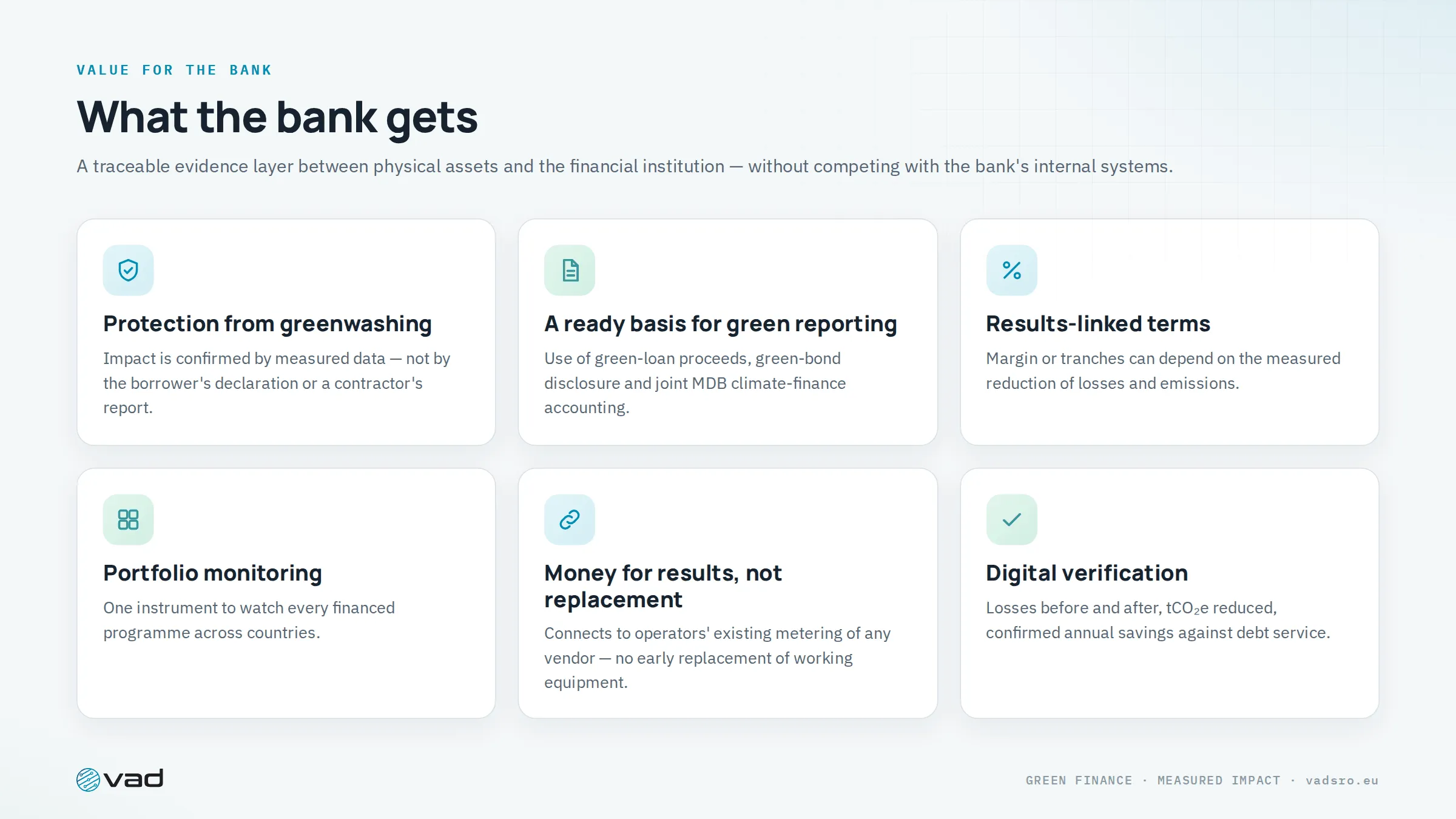
VAD does not compete with banks’ internal systems. It supplies a traceable evidence layer: physical asset → trusted evidence → financial institution.
What the Bank Gets
Protection from greenwashing — impact is confirmed by measured data, not by the borrower’s declaration or a contractor’s report.
A ready basis for green reporting — on the use of green-loan proceeds, for the disclosure of the green bonds that fund such loans, and for accounting under the joint MDB climate-finance methodology.
Results-linked terms — the margin or tranches of a loan can depend on the measured reduction of losses and emissions.
Portfolio monitoring — one instrument to watch every financed programme across countries.
Money for results, not replacement — the platform connects to the operator’s existing metering systems of any manufacturer, so the bank does not have to finance early replacement of working equipment.
Digital verification — measured losses before and after, actual consumption, tonnes of CO₂-equivalent reduced and confirmed annual savings set against debt service. VAD is responsible for the integrity of the data chain up to the report.
One Multi-Country Programme, Three Directions
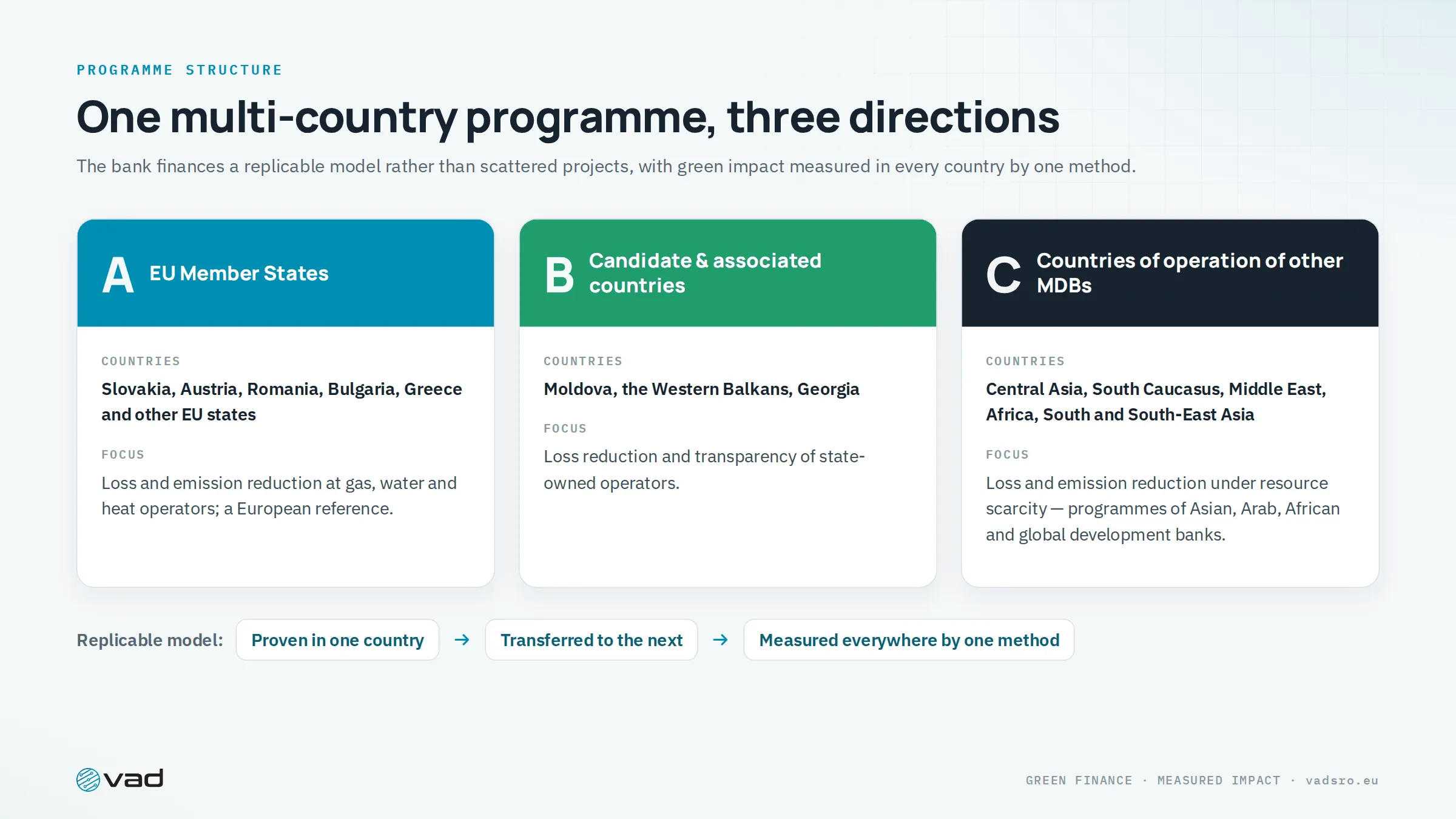
VAD proposes a single multi-country programme on a common technology base. The bank finances not scattered projects but a replicable model: a solution proven in one country is transferred to the next, and the green impact is measured in every country by one method.
| Direction | Countries | Focus |
|---|---|---|
| A · EU Member States | Slovakia, Austria, Romania, Bulgaria, Greece and other EU states | Loss and emission reduction at gas, water and heat operators; a European reference |
| B · Candidate and associated countries | Moldova, the Western Balkans, Georgia | Loss reduction; transparency of state-owned operators |
| C · Countries of operation of other development banks | Central Asia, South Caucasus, Middle East, Africa, South and South-East Asia | Loss and emission reduction under resource scarcity — programmes of Asian, Arab, African and global development banks |
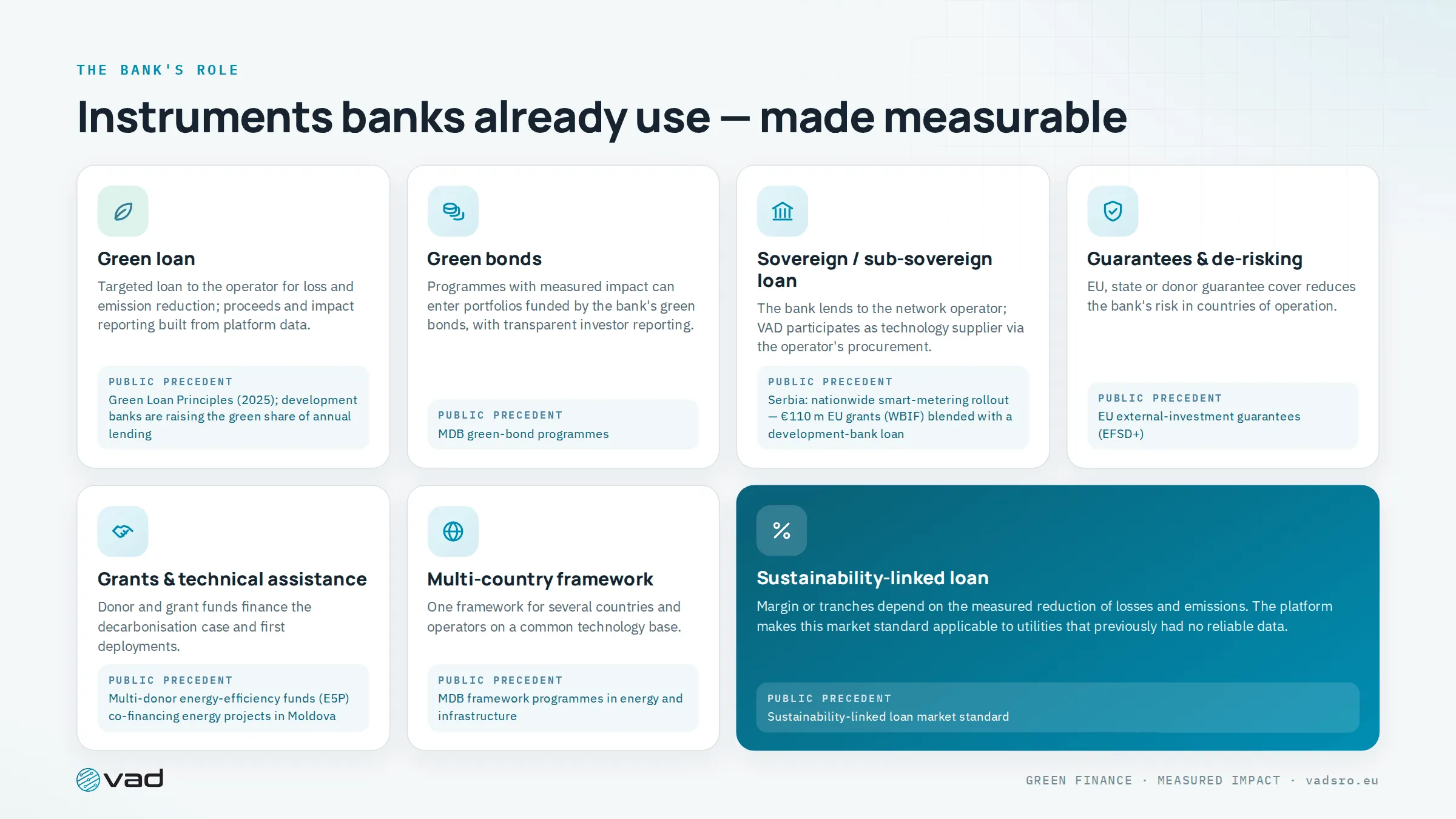
Instruments Banks Already Use — Made Measurable
The combination of instruments is defined for each country and operator together with the bank.
| Instrument | How it applies | Public precedent |
|---|---|---|
| Green loan | Targeted loan to the operator for loss and emission reduction; proceeds and impact reporting built from platform data | Green Loan Principles (2025); development banks are raising the green share of annual lending |
| Green bonds | Programmes with measured impact can enter portfolios funded by the bank’s green bonds, with transparent investor reporting | MDB green-bond programmes |
| Sovereign or sub-sovereign loan | The bank lends to the network operator; VAD participates as technology supplier through the operator’s procurement | Serbia: nationwide smart-metering rollout — €110 m EU grants (WBIF) blended with a development-bank loan |
| Guarantees and de-risking | EU, state or donor guarantee cover reduces the bank’s risk in countries of operation | EU guarantees for external investment (EFSD+) |
| Grants and technical assistance | Donor and grant funds finance the decarbonisation case and first deployments | Multi-donor energy-efficiency funds (E5P) co-financing energy projects in Moldova |
| Multi-country framework | One framework for several countries and operators on a common technology base | MDB framework programmes in energy and infrastructure |
| Sustainability-linked loan | Margin or tranches depend on the measured reduction of losses and emissions | Market standard — now applicable to utilities that previously had no reliable data |
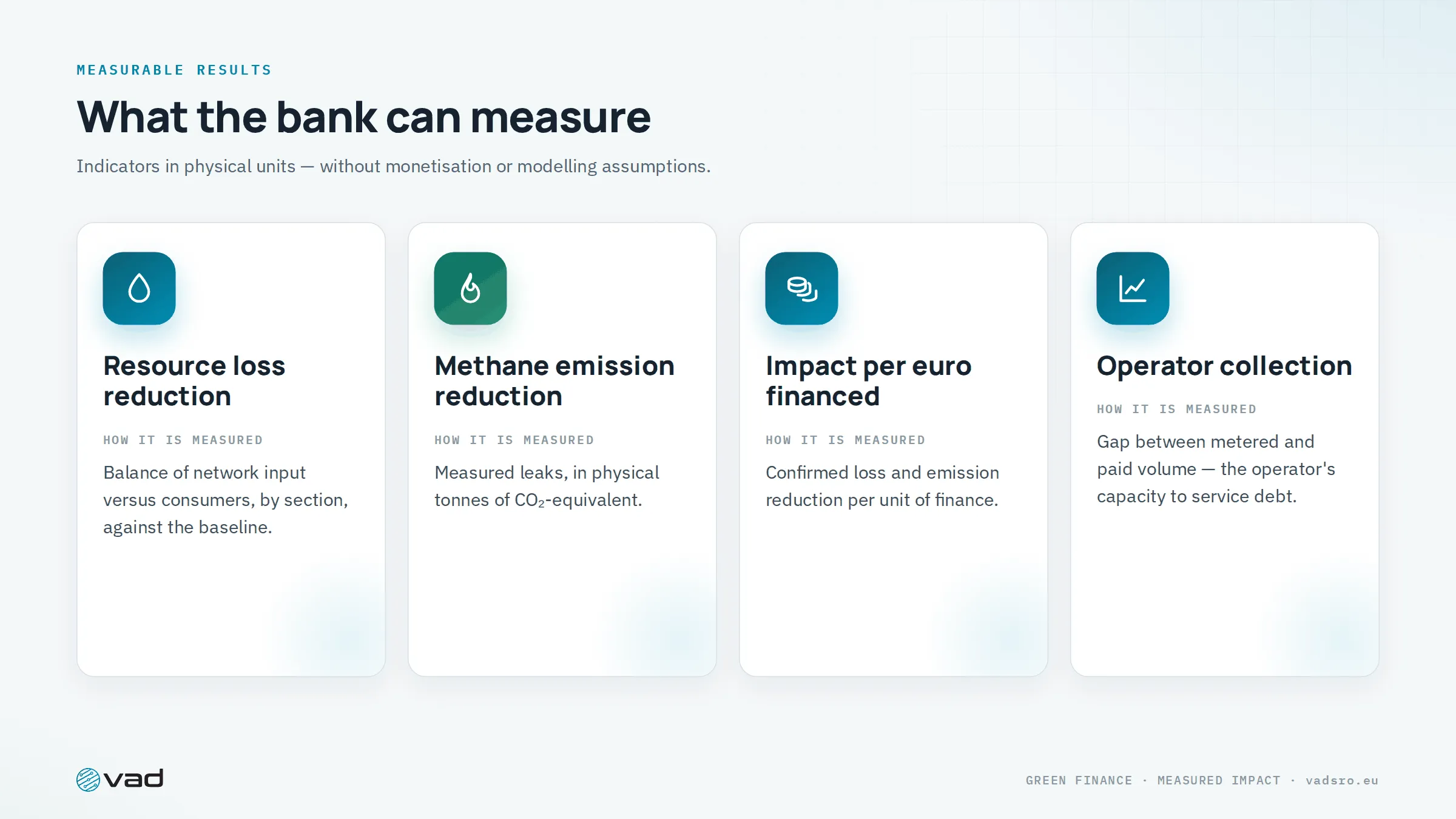
Measurable Results for the Bank
| Indicator | How it is measured |
|---|---|
| Resource loss reduction | Balance of network input versus consumers, by section, against the baseline |
| Methane emission reduction | Measured leaks, in physical tonnes of CO₂-equivalent, without monetisation |
| Impact per unit of finance | Confirmed loss and emission reduction per euro invested |
| Operator collection | Gap between metered and paid volume — the operator’s capacity to service debt |
Phased Implementation and Technical Support
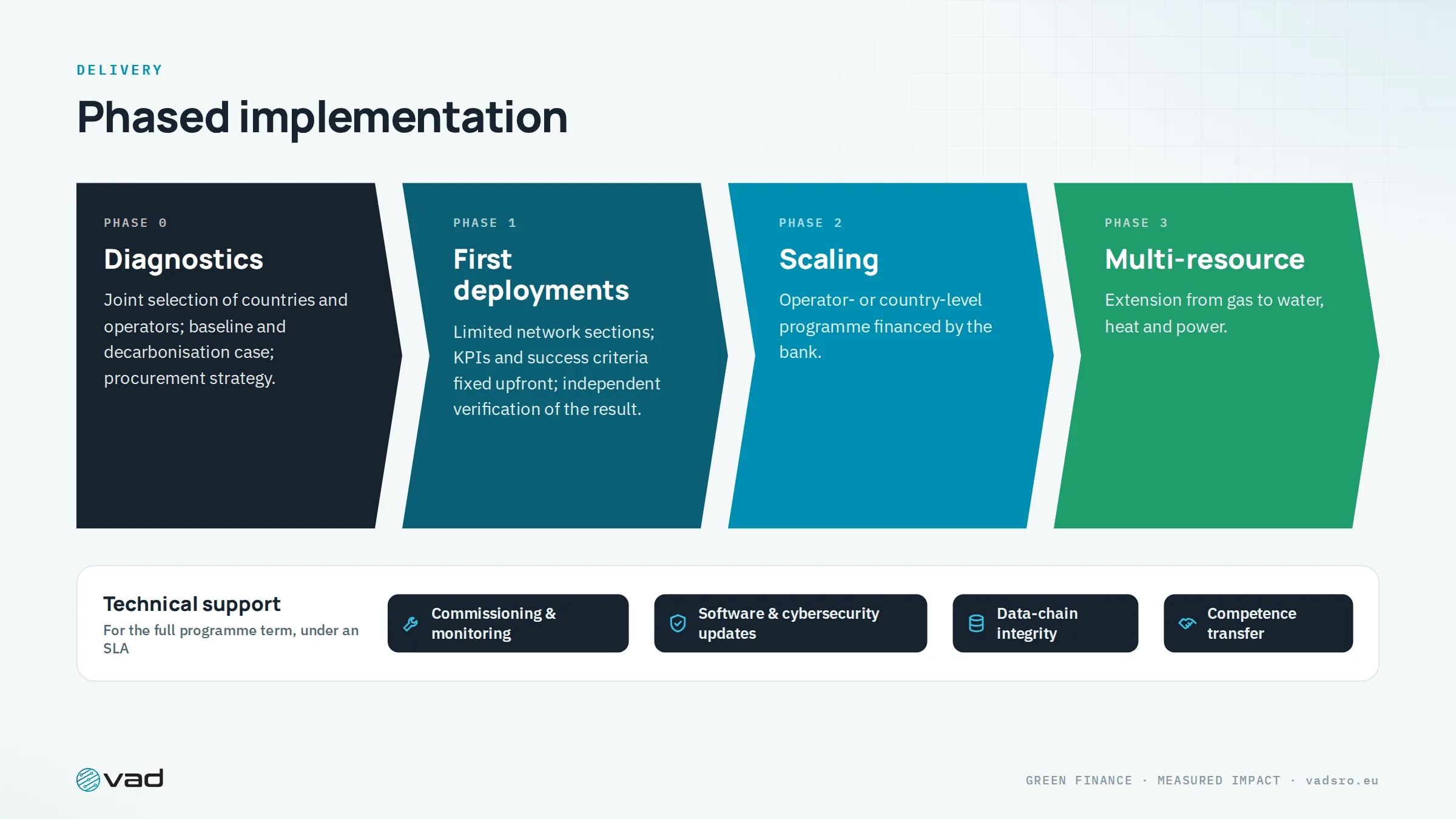
Phase 0 · Diagnostics — joint selection of countries and operators with the bank; baseline and decarbonisation case; procurement strategy.
Phase 1 · First deployments — limited network sections; KPIs and success criteria fixed in advance; independent verification of the result.
Phase 2 · Scaling — an operator- or country-level programme financed by the bank.
Phase 3 · Multi-resource — extension from gas to water, heat and power.
VAD provides technical support for the full term of the programme, extendable by decision of the bank and the client. Support covers commissioning, platform monitoring, software and cybersecurity updates, staff training and the integrity of the data chain for verification and green reporting, under a service level agreement.
Alignment with IFI Requirements
Procurement — projects financed by the bank follow the procurement rules of the bank and the client.
Green reporting — platform data enable the borrower to meet the requirements to assess, quantify and disclose environmental benefits; qualification follows the bank’s methodology.
Transparency and intellectual property — a European legal entity; all intellectual property is consolidated in the company.
Data — information security aligned with ISO 27001; in-country data storage; GDPR compliance.
Why VAD
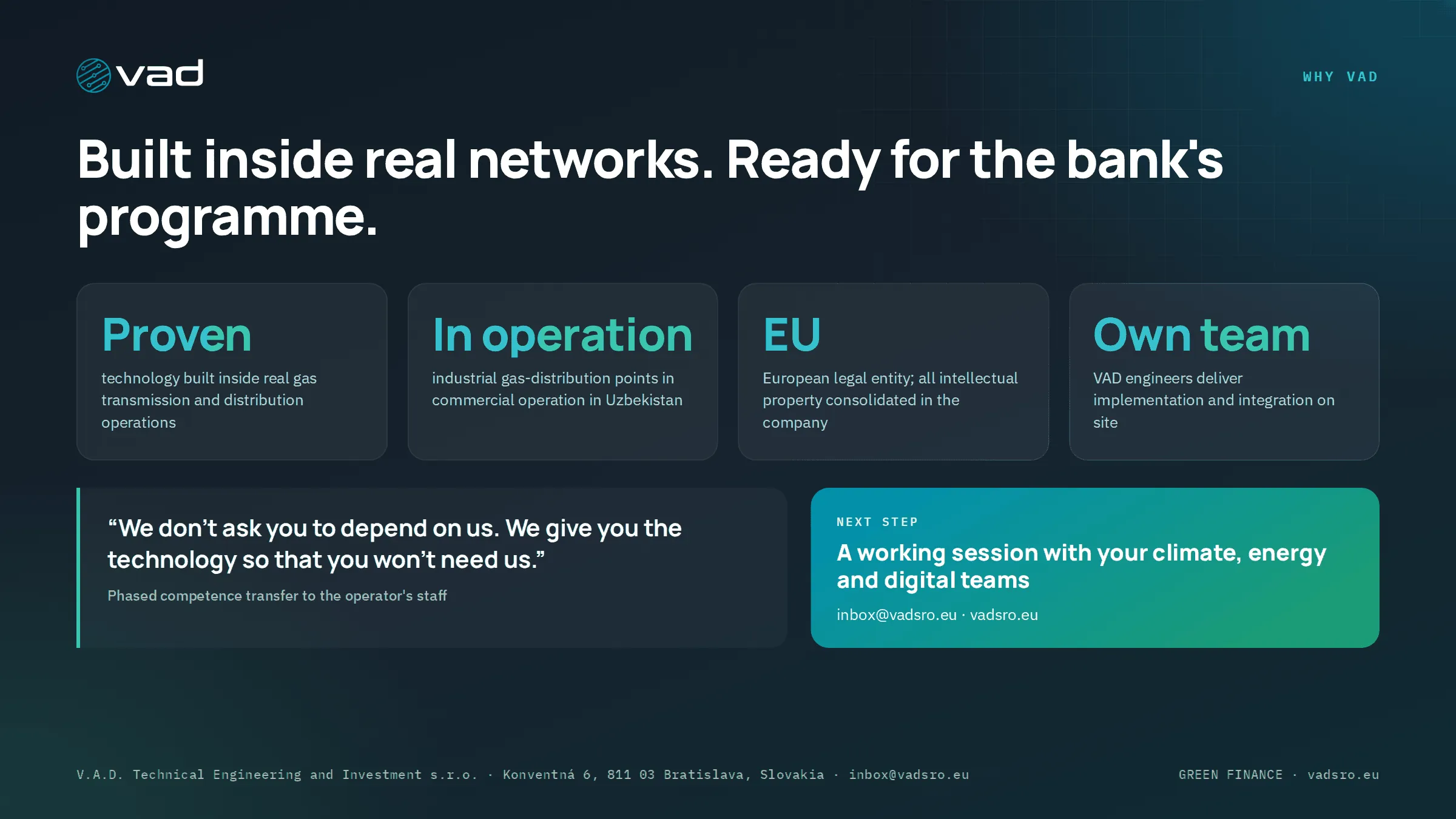
V.A.D. Technical Engineering and Investment s.r.o. is a Slovak engineering and technology company and the rights holder of an industrial IIoT ecosystem for digital management of critical infrastructure — gas, water, heat and power. The technology was built inside real gas transmission and distribution operations and runs in commercial operation at industrial gas-distribution points in Uzbekistan. VAD’s own engineering team carries out implementation and integration at the client’s site rather than only transferring technology.
“We don’t ask you to depend on us. We give you the technology so that you won’t need us.”
| Region | Address | Contact |
|---|---|---|
| Europe · HQ | Konventná 6, 811 03 Bratislava, Slovakia | +421 910 411 379 · inbox@vadsro.eu |
| MENA | Standard Chartered Tower, L5, Emaar Sq., Dubai, UAE | +971 585 947 197 · inbox.mena@vadsro.eu |
| Americas | 305 Central Avenue, Plainfield, NJ 07060, USA | +1 973 868 1855 · inbox.usa@vadsro.eu |
| Asia | Shota Rustaveli 45, Tashkent, Uzbekistan | +998 93 133 11 18 · inbox@utesol.uz |
Contact
A way for the bank to finance the decarbonisation of networks so that every result is visible and measured.
Proposed next steps — a working session with the bank’s climate, energy and digital teams; defining the green qualification of the programme under the bank’s methodology; joint selection of the first countries and operators; identifying technical-assistance sources for the decarbonisation case and first deployments; joint structuring of the financial model.
- Company
- V.A.D. Technical Engineering and Investment s.r.o., Bratislava, Slovakia, EU
- Data Platform
- docs.vadsro.eu · API reference
- Web
- vadsro.eu / solutions / measurable-green-finance
- inbox@vadsro.eu — programmes and partnerships
Public data sources: 2025 Joint Report on Multilateral Development Banks’ Climate Finance (13 July 2026); Joint MDB Statement at COP29, Baku (12 November 2024); public information on EU blended finance for smart metering in Serbia (WBIF) and on E5P co-financing in Moldova; LMA, APLMA and LSTA Green Loan Principles (2025). Platform screens are shown with an illustrative dataset and masked values. Final qualification of any project is determined under the methodology of the financing bank.
More solutions
All solutions
Oil & Gas IoT
Industrial IoT for oil & gas and gas utility operators: gas volume correctors, flow computers, RTUs, valve control and the Data Platform with SCADA, ERP and GIS integration. EU-manufactured.
Learn more
Telecom IoT
EU-manufactured industrial IoT for telecom operators: smart gas and water meters, ATEX sensors, Data Platform. OEM, white-label, escrow, Full IP transfer.
Learn more