


Industrial IoT for Oil & Gas Operators
Industrial IoT in oil & gas rarely starts from a clean sheet. Operator infrastructure typically combines gas volume correctors, flow computers, RTUs, valves, controllers and localized operating interfaces from different vendors and successive modernization cycles. Data collection, event handling, archive access and equipment control end up split across separate systems.
VAD addresses this with the IIoT Platform — the central software component of the VAD IIoT Ecosystem — built for oil & gas and gas utility digitalization, from a single metering node to a multi-level enterprise rollout. The platform consolidates telemetry, control, archival data, operational events and secure integrations into one operating environment, while preserving flexibility in deployment, localization and ownership models.
The Problem
Most oil & gas and gas utility operators already run a mixed installed base — gas volume correctors and metering devices from European and North American vendors such as Honeywell (including Elster and RMG), Itron, Dresser (Baker Hughes) and RMA. The devices are not the problem; the missing digital backbone around them is.
Typical pain points include:
- Heterogeneous equipment with different vendor logic, different interfaces and different generations of hardware.
- Fragmented data capture, where readings, archives and alarms remain isolated inside separate local systems.
- No unified control layer — station-level control runs locally and inconsistently.
- Difficult support and scaling, because every new site or device family increases architectural complexity.

The operational consequence is straightforward: slower response, lower transparency, weaker control and higher cost of support.
Solution Architecture
VAD consolidates field telemetry, control commands, archival data and enterprise integrations into one operating environment.
One Data Backbone for Heterogeneous Correctors and Metering Nodes
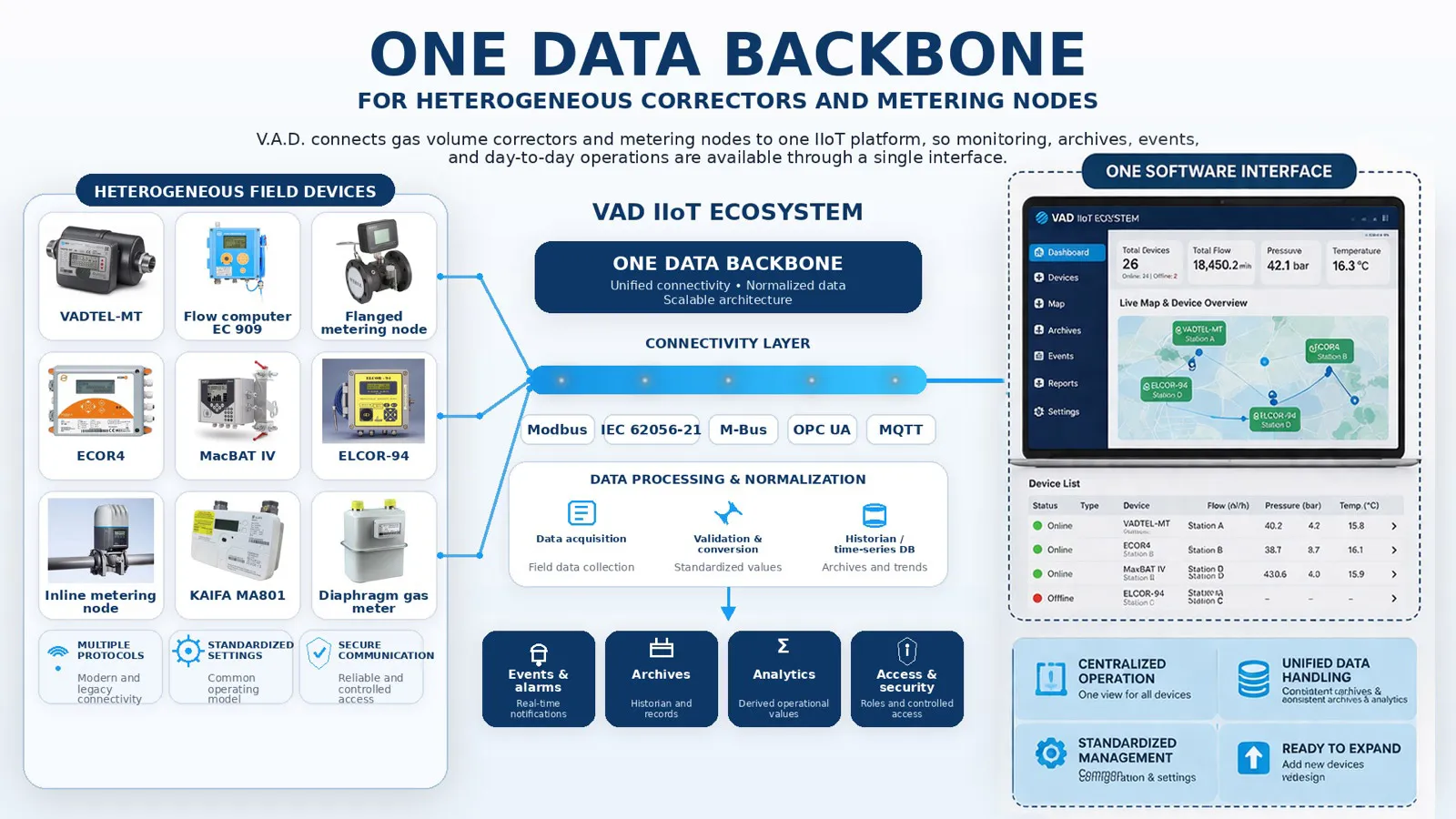
VAD connects gas volume correctors and metering nodes to the IIoT Platform, so monitoring, archives, events and day-to-day operations sit behind one interface. Instead of maintaining multiple isolated silos, operators run a centralized operating model with standardized settings, unified data handling and room for expansion without redesigning the whole architecture.
Unified Controller for Valve, Corrector and Tamper Events
For metering-node scenarios, VAD supplies a unified controller — VADTel-ValveLink — that combines valve control, corrector integration and tamper detection inside one device. This reduces failure points, simplifies installation and maintenance and improves operational reliability at gas metering nodes.
One Interface for Valve Operation
The IIoT Platform includes a dedicated metering-node card where operators can issue open and close commands, monitor position feedback, track intermediate states and keep an event log in one place. One interface for command execution, position monitoring and event tracking replaces fragmented local tools.
API Integration with Enterprise Systems
The IIoT Platform integrates with enterprise systems through a documented REST API. Practical integration scenarios include ERP, billing, dispatch, SCADA, GIS and analytics environments. The result is one information space for measurements, equipment states and event data, with role-based control and auditability preserved throughout.
Architecture and Scale
The IIoT Platform scales from an individual site to a distributed operating model with multiple organizational layers. A typical structure includes:
- Corporate layer for standards, roles, security policy and KPIs.
- Regional layer for branch operations, asset groups and access control.
- Service-area or dispatch layer for events, service workflows and integrations.
- Site layer for metering nodes, valves, controllers and local measurement assets.
This approach supports centralized visibility with local execution, policy inheritance across the structure and expansion into new regions or sites without re-architecting the platform core.
Security and Sovereignty
Security is part of the operating model, not an add-on. For oil & gas infrastructure, VAD applies a four-layer defense across the path from field sensor to platform — the same architecture used across the VAD IIoT Ecosystem.
Multi-Layer Protection Architecture
The IIoT Platform security model spans four layers:
- Edge: signed firmware with secure boot on RTUs and field controllers, tamper-evident enclosures, ATEX intrinsic-safety barriers where assets sit in hazardous zones and tamper-detection inputs at metering nodes.
- Transport: TLS 1.3 with mutual authentication and per-device certificates, encrypted cellular tunnels over GSM, GPRS, NB-IoT and LTE-M, VPN access for operators, network segmentation or dedicated APN, plus IDS/IPS, NGFW and DDoS protection.
- Platform: physically protected data centers with access control, CCTV and power/climate redundancy; containerized services on SELinux or AppArmor with hardening and patching; MFA, OAuth2/OIDC, RBAC and application-level protection against CSRF, XSS and SQLi; full audit logging of every reading, alert and operator action.
- Storage: AES-256 encryption at rest, key management on HSM/KMS, 3-2-1 backup strategy, geographic data residency and EU-sovereign hosting by default.
Data Portability and Third-Party Access Control
The IIoT Platform supports controlled data sharing and portability. This includes third-party access control, REST API and JSON-based exchange, end-user export scenarios and data-export workflows that reduce vendor lock-in. For projects with regulatory, corporate or partner reporting requirements, the operator keeps control over who gets access, what is exported and in which format.
Independent Platform Core
For critical installations, architectural independence matters. The IIoT Platform runs as an independent operating environment, built on proprietary code with no required third-party runtime components in the mission-critical stack. The result is a foundation for long-term support, predictable operation and certification-oriented projects.
Multilingual Workflows and External Access
Localization and external access run as project-driven configurations on top of the same platform core.
Interfaces and Documentation in the Selected Language
Localization is project-driven. User interfaces, reports, notifications, forms, directories, terminology and technical documentation switch to the language selected by the operator or end user, without changing platform logic or API behavior. This matters for multi-country operators, local service contractors and consumer-facing deployments.
Isolated Replica Server for External Access
When regulators, partner operators, downstream billing systems or end consumers need access to current information, VAD supports a replica-server model. One-way replication copies data from the primary environment to an isolated replica server. Users access a read-only portal with no reverse connection to the primary control environment. This preserves security of the main operating environment while enabling transparent external access to approved data.
Software and Hardware Ecosystem
The VAD oil & gas offering is not limited to software. VAD can deliver the IIoT Platform as an integrated software + hardware solution with guaranteed compatibility between field equipment and the digital layer.
Software Scope
- IIoT Platform for data processing, storage, visualization and archive access.
- Dashboards, trends, alerts and reporting workflows.
- API layer for enterprise exchange and integration.
- Security and administration functions including roles, access rights and event logs.
Telemetry Device Scope
- RTUs and field controllers for acquisition and transfer of field data.
- Measuring instruments such as flow computers, pressure sensors, temperature sensors and level-related telemetry devices.
- Actuators including valves, gate valves and control relays.
- Communications modules for GSM, GPRS, NB-IoT and LTE-M.
A typical implementation path includes design, supply and setup, deployment and commissioning, then unified operation inside one control environment.
Deployment and Collaboration Models
Oil & gas customers often need more than a standard SaaS offer. VAD therefore supports multiple ownership and deployment options depending on contractual, security and operational requirements.
Deployment Options
- On-premise or private cloud.
- Managed dedicated cloud.
- Hybrid model for integrations and redundancy.
- Co-managed operation with phased handover.
Engagement Formats
VAD can deliver the platform as a licensed solution, a managed deployment, or a project with phased transfer of rights and source materials. Named commercial models include source-code transfer under escrow with business-continuity arrangements and Full IP transfer for sovereign deployments. This range lets operators start with a pilot, adapt the configuration to their infrastructure and scale in an agreed operating model without functional lock-in.
Transferable Project Materials
Depending on the project model, deliverables may include source code and repositories, technical documentation, integration schemes, data structures, training and access handover. The exact scope is fixed by contract and project requirements.
Operator Outcomes
For oil & gas operators, the value proposition is operational rather than purely technical:
- Security: access control, audit trail and data protection for mission-critical infrastructure.
- Fast start: pilot, configuration and phased scaling based on the real project scope.
- Interoperability: API-based integration with ERP, billing, SCADA, GIS and adjacent systems.
- Cost optimization: process automation, better transparency and lower integration overhead.
- Scalability: from a single site to a distributed enterprise network.